


Can nut-free snacks still contain traces of nuts?
Editorial Team
Yes, snacks described as nut-free can contain unintended traces of peanuts or tree nuts through cross-contact during growing, manufacturing, packing, or preparation. For school snacks in 2026, check the current package and the manufacturer’s allergen information rather than treating a front-of-bag claim as proof that a snack meets your child’s allergy plan.
TL;DR
- Can nut-free snacks contain nut traces? Yes—unintended allergen cross-contact is possible.
- FDA precautionary allergen warnings are voluntary; no warning does not prove the absence of cross-contact.
- Naturesturn makes 100% fruit snacks with no added sugar; those claims do not establish nut-allergy suitability.
- Check the current label, manufacturer’s information, school policy, and your child’s individual allergy plan before packing.
Can nut-free snacks still contain traces of nuts?
Yes. A snack’s intended ingredients and its possible exposure to allergens are separate questions. Peanuts or tree nuts can enter a food unintentionally when ingredients, equipment, utensils, or preparation surfaces come into contact with them.
That does not mean every snack labeled nut-free contains nuts. It means you need to understand what the claim covers and whether the information supports your child’s needs.
These common label statements answer different questions:
| Statement | What it tells you | What it does not establish |
|---|---|---|
| Nut-free | The manufacturer makes a claim about the food | The exact controls or testing behind that claim |
| No nuts in the ingredient list | Nuts are not listed as intentional ingredients | Whether unintended cross-contact is possible |
| May contain peanuts or tree nuts | The manufacturer identifies a possible unintended allergen presence | How much allergen is present in a particular package |
| Made on shared equipment | Equipment is used for foods involving the named allergen | A measurable risk level for your child |
| Made in a facility that also processes nuts | The named allergen is handled at the facility | Whether the snack uses the same production equipment |
| No precautionary warning | No voluntary warning appears on that package | That the facility or food is free from cross-contact |
Peanuts and tree nuts are also different allergen categories. If a school asks for peanut-free snacks, do not automatically read that as permission to send tree nuts; check the written policy. The guide to nut-free snacks versus peanut-free snacks explains that distinction.
Why this matters for a school lunchbox
A familiar snack can feel like an easy decision at a busy breakfast table. But a flavor name, fruit-only ingredient list, or package you recognize does not replace an allergen check.
For 2026 school planning, separate the school’s snack policy from your child’s medical instructions. A classroom rule sets expectations for that shared space; your child’s allergy plan guides the precautions needed for your child. A snack must meet both where both apply.
The practical benefit of a repeatable routine is simple: you do not have to make the whole decision again while hunting for a missing lunchbox lid. Read the package when buying, resolve questions before packing day, and keep the label available for the adult supervising snack time.
What does the FDA require on U.S. food labels?
The FDA identifies 9 major food allergens under U.S. law: milk, eggs, fish, crustacean shellfish, tree nuts, peanuts, wheat, soybeans, and sesame. For packaged foods under FDA jurisdiction, major allergens used as ingredients must be declared according to federal labeling requirements.
An allergen can appear in the ingredient list, including in parentheses after an ingredient, or in a separate Contains statement. Do not look only for a Contains box. Read the complete ingredient list as well.
FDA food-allergen labeling guidance also distinguishes required ingredient declarations from voluntary precautionary statements, such as may contain. In 2026, that distinction remains central to reading a snack label: the absence of a voluntary statement does not demonstrate the absence of unintended allergen exposure.
These statements are not a scale you can use to rank snacks from safest to least safe. A shared-facility warning does not provide a measured amount, and a shared-equipment warning does not tell you how a manufacturer’s controls perform. Ask about the actual product rather than comparing the wording alone.
Also remember the scope. FDA requirements do not cover every food in every setting in the same way; homemade classroom treats and food repacked into an unmarked container do not give you the same labeling information as the original packaged product.
Why the possibility of nut traces varies
Unintended cross-contact depends on how a particular food is sourced, handled, and packed—not simply on whether its main ingredient is fruit, oats, or another food.
- Ingredient handling: An ingredient can encounter allergens before it reaches the final snack manufacturer. A short ingredient list does not describe the supplier’s handling practices.
- Shared equipment: Production equipment can transfer allergen residue between foods when controls do not adequately prevent cross-contact.
- Shared utensils and surfaces: Scoops, trays, counters, and containers can transfer allergen residue during preparation or packing.
- Manufacturing controls: Supplier checks, separation, cleaning, and other allergen controls affect how a manufacturer manages unintended exposure.
- Handling after opening: A snack that meets a family’s requirements can encounter nuts when someone pours it into a shared bowl or handles it while preparing another food.
None of these factors lets you calculate your child’s reaction risk from a package alone. Use them to ask focused questions—not to create a homemade risk score.
How do you check a snack before packing it?
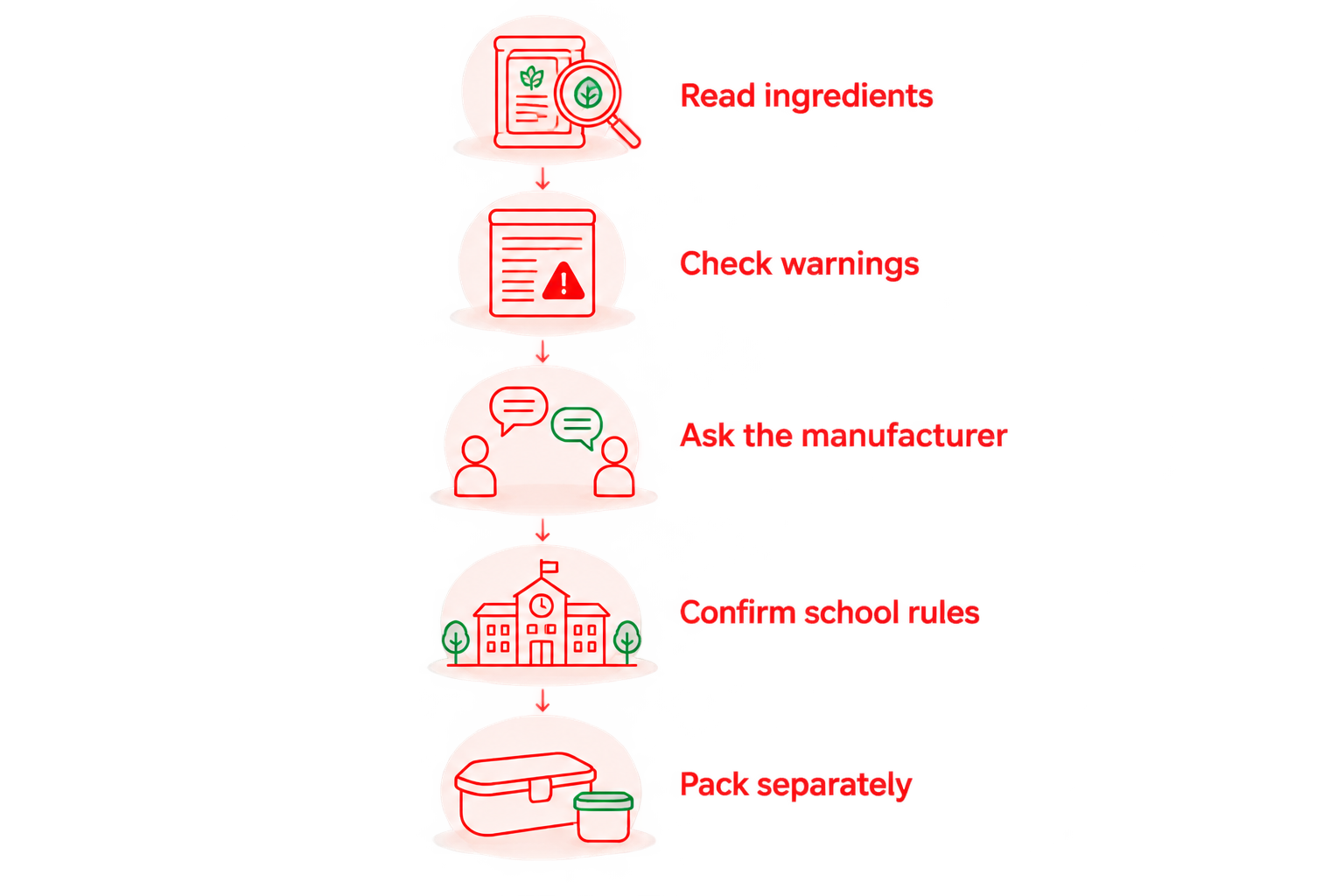
Use these 5 checks for your 2026 lunchbox routine. They apply to fruit snacks as well as crackers, cereal snacks, and other packaged foods.
- Read ingredients. Check the actual package you plan to send, including every part of a mixed snack. Do not rely only on an online listing or a label remembered from a previous purchase.
- Check warnings. Read the Contains statement if present and any precautionary allergen wording. Treat an unclear or conflicting claim as a reason to pause and ask—not as permission to pack.
- Ask the manufacturer. Identify the exact flavor, package size, and lot information when available. Ask about the allergens your child needs to avoid and the controls used for that product.
- Confirm school rules. Check whether the classroom accepts foods with precautionary warnings and whether original packaging is required. For a shared event, ask the organizer before buying snacks for everyone.
- Pack separately. Follow your child’s plan for clean hands, utensils, containers, and preparation surfaces. Keep the original label with the snack when school rules or the supervising adult require it.
If you cannot resolve an allergen question, do not use that snack as an experiment. Choose a food already consistent with the child’s established allergy plan and the school’s requirements.
This routine also helps relatives and sitters. Instead of saying that any fruit snack is fine, share the exact product information and the checking steps your family follows. Clear instructions are more useful than a broad food-category label.
What should you ask the snack manufacturer?
Start with 3 questions that keep the conversation specific. Have the package nearby so the reply refers to the right food rather than the brand in general.
- Does this exact product contain peanut or tree-nut ingredients?
- Is it made on equipment or in a facility that also handles those allergens?
- What controls address unintended allergen cross-contact for this product?
If the package says nut-free but also carries a precautionary nut warning, ask the company to explain the apparent conflict. Do not decide for yourself that one statement cancels out the other.
A reply about ingredients alone does not answer a question about shared equipment. Likewise, a statement about a facility does not automatically describe every supplier or production line. Ask a follow-up when the answer addresses a different question from the one you asked.
Keep useful product-specific replies where other caregivers can find them, together with the package details. Recheck when the label, product, or manufacturer’s information changes; a saved message should support your routine, not replace reading the current bag.
Where do freeze-dried fruit snacks fit?
Naturesturn freeze-dried fruit snacks are best for families seeking 100% fruit snacks with no added sugar. That describes their ingredients and appeal; it is not an allergy-safety guarantee.
The benefit of a simple fruit snack is straightforward ingredient reading. The limitation is just as important: even a single-ingredient food still needs an allergen review when a child has a food allergy. Freeze-drying is a food-preservation process, not proof of nut-free handling.
Naturesturn’s Freeze-Dried Fruit Crisps Lunchbox Snack Variety Pack contains strawberry, apple, and pear in small, single-serve bags. Those bags offer a school-day format, but neither the format nor the fruit flavors establish suitability for a particular allergy.
For a product-specific question, use the customer contact page and identify the exact item. Confirm the current label and relevant manufacturing information before treating any product as a match for your child’s plan.
Also keep sugar claims separate from allergen claims. No added sugar does not mean sugar-free: fruit contains naturally occurring sugar. Neither statement answers whether a food has encountered peanuts or tree nuts.
Is a snack without a may-contain warning safe for a nut allergy?
No warning is not proof of no cross-contact. Precautionary allergen statements are voluntary under FDA guidance, so their absence does not establish that a food meets an individual allergy plan.
Read the full label and seek product-specific information where needed. Do not replace a clear instruction from your child’s allergy care team with an assumption based on missing wording.
Does a nut-free classroom mean every snack is safe?
A nut-free classroom rule does not guarantee an allergen-free environment. The rule describes what people are expected to bring; it does not verify every ingredient, manufacturing practice, or preparation surface.
For your 2026 school handoff, confirm who checks snacks, how shared celebrations are handled, and how the school follows your child’s emergency plan. Keep those practical arrangements separate from choosing a snack brand.
Can you remove nuts from a snack mix and serve the rest?
No—picking out visible nuts does not remove allergen residue. The remaining food has already been in contact with the nuts, so it is not an appropriate way to prepare a snack for someone who needs to avoid them.
The same principle applies to a serving bowl or scoop previously used for nuts. Follow the cleaning and food-handling instructions in the child’s plan rather than judging a surface by whether it looks clean.
FAQ
Can nut-free snacks contain nut traces even when nuts are not ingredients?
Yes, unintended nut traces can result from allergen cross-contact even when nuts are not intentional ingredients. Check the current label, manufacturer’s information, and your child’s allergy plan.
Does may contain nuts mean the snack definitely contains nuts?
No, may contain identifies possible unintended allergen presence rather than confirming nuts in every package. It does not state an amount or establish suitability for your child.
Is made in a shared facility safer than made on shared equipment?
Those phrases do not provide a standardized risk ranking. Ask about the exact product and its allergen controls instead of choosing based on warning wording alone.
Are peanut-free and tree-nut-free the same thing?
No, peanuts and tree nuts are different allergen categories. Read the school’s policy and your child’s allergy plan to identify which foods must be avoided.
Can I send homemade nut-free snacks for a class celebration?
Only send homemade snacks if the school permits them and the arrangements meet the affected children’s allergy requirements. Leaving nuts out of a recipe does not address cross-contact from ingredients, utensils, or surfaces.
Are Naturesturn fruit snacks safe for every child with a nut allergy?
No snack should be assumed suitable for every child with a nut allergy. Check the exact product’s current label and manufacturer’s allergen information against the child’s individual plan.
What should I do if my child reacts after eating a snack?
Follow your child’s allergy emergency action plan immediately and seek emergency help as directed. Do not dismiss symptoms because the snack was described as nut-free.
One last thing
The original wrapper is part of the snack handoff. Pouring an otherwise suitable snack into an unmarked bag removes the ingredient and allergen information the next caregiver needs to check.
For your 2026 school-snack routine, keep the wrapper available, avoid mixing different snacks into a shared container, and tell supervising adults when you have substituted a product. A familiar-looking snack is not the same as a verified label.