


How to check allergy-friendly snacks before a class celebration
Editorial Team
Check allergy friendly snacks by matching the exact package label to the classroom’s food rules and the affected child’s school-approved allergy plan before you buy or serve anything. For a 2026 class celebration, read the ingredients, allergen statement, and any cross-contact warnings, then have the designated school contact confirm the choice. A familiar brand, a short ingredient list, or a missing warning does not establish that a snack is suitable for every child.
TL;DR
- Choose allergy friendly snacks by checking the exact label against classroom rules and individual allergy plans.
- Read ingredients and cross-contact warnings; a missing advisory statement is not a safety guarantee.
- Naturesturn sells 100% fruit snacks with no added sugar; those claims do not establish allergy suitability.
- Keep original packaging, prevent snack swapping, and let school staff manage approval and serving.
Why this matters
Packing your own child’s snack and bringing food for a whole classroom are different jobs. A snack your family enjoys still needs a separate check before it goes on a celebration table. The classroom’s rules and individual allergy plans decide what belongs there—not the words on the front of the bag.
Simple ingredients help you understand what you are buying. Naturesturn sells freeze-dried fruit snacks made with 100% fruit and no added sugar, but those descriptions do not answer questions about shared equipment or individual allergies. Keep ingredient simplicity and allergy suitability as separate checks.
For U.S. label reading in 2026, the FDA identifies 9 major food allergens: milk, eggs, fish, crustacean shellfish, tree nuts, peanuts, wheat, soybeans, and sesame. That list guides federal labeling requirements; it is not a complete list of everything a child can be allergic to. Ask about the child’s actual restrictions rather than working from a standard list alone.
How do you check allergy friendly snacks before a class celebration?
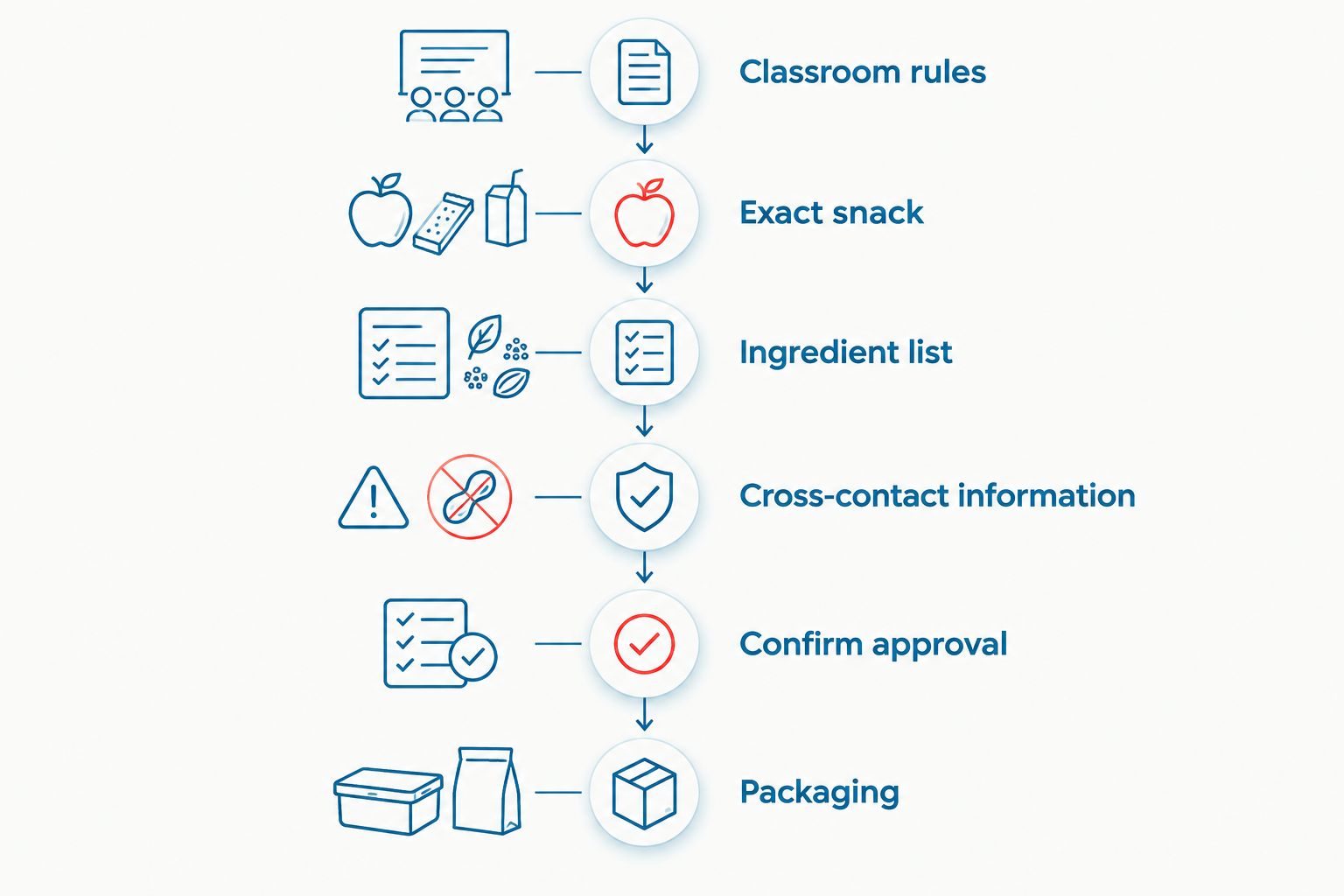
Use this sequence before shopping, again when the package arrives, and once more before serving. If a check leaves an unanswered question, pause that snack choice rather than treating uncertainty as approval.
1. Get the classroom rules first
Ask the teacher or designated school contact what food is permitted for the celebration. Find out whether food must be commercially packaged, whether homemade food is allowed, and who approves proposed snacks. Request the current instructions rather than relying on what another class accepted.
For a 2026 celebration, an old party list is not a substitute for current classroom guidance. A different classroom, student group, or school policy changes the decision. Ask early enough to choose something else without making a rushed substitution at drop-off.
You do not need another child’s private medical details. You need the school’s practical instructions about what to bring and how it will be handled.
2. Identify the exact snack and flavor
Write down the specific product, flavor, and package format you intend to send. Do not submit a general description such as fruit snacks or crackers when the school needs to review a label. Different flavors can contain different ingredients.
If you are considering a variety pack, check every included flavor separately. An approved flavor does not approve the entire assortment. Keep unreviewed flavors out of the classroom selection, even when the packages look similar.
A photo of the front, ingredients, allergen information, and manufacturer details helps the school contact identify the exact item. Make sure the text is readable and the photos belong to the package you plan to bring.
3. Read the complete ingredient list
Look for the child’s restricted ingredients throughout the list, not just in a bold statement. Under U.S. FDA labeling rules for packaged foods, major allergens must be identified through the ingredient list or a separate contains statement; a separate statement is not always present.
A child’s allergy can also involve an ingredient outside the major-allergen groups. Read every ingredient against the instructions provided through the school, and ask for clarification if an ingredient is unfamiliar. Do not guess that an unfamiliar name is harmless.
Front-of-package descriptions have narrower meanings. No added sugar does not mean sugar-free, and neither description establishes whether a product meets an allergy plan. Fruit naturally contains sugar, even when no sugar is added.
4. Check cross-contact information separately
Cross-contact happens when an allergen unintentionally gets into another food, including through shared equipment, utensils, or handling. Look for advisory wording about possible allergen presence, shared equipment, or shared facilities. These statements address a different question from the ingredient list.
In the United States, precautionary allergen statements are voluntary. Their absence does not establish that a product was made without cross-contact risk. Likewise, the wording alone does not give you a reliable scale for comparing the risk of different products.
When the school’s instructions require manufacturing information that the label does not provide, contact the manufacturer about the exact item. Pass the response to the designated school contact. Do not make a safety decision on another family’s behalf.
5. Confirm approval before substituting
Send the proposed snack information through the school’s requested process. Ask for confirmation before buying the classroom quantity or packing the celebration bag. A parent group chat can help coordinate shopping, but it does not replace the school’s approval process.
If you bring a different flavor, size, or product, repeat the check. Do the same if the package you receive differs from the information previously reviewed. An approved shopping plan is only useful when the food that arrives matches it.
Keep a note of the confirmed choice with your celebration supplies. That makes it easier to avoid an accidental swap during a busy school morning.
6. Keep the packaging and serving plan together
Bring the original packaging so school staff can review the label at serving time. Individually wrapped portions help keep food identifiable, but the wrapper itself does not make the contents suitable. For food served from a larger package, ask staff how they want the label retained.
Follow the school’s instructions for handwashing, surfaces, utensils, and distribution. Do not combine reviewed snacks with unreviewed toppings or let children trade food. A carefully checked snack still needs careful handling once the celebration starts.
Which celebration format is easiest to check?
Choose the format the school permits, then consider how clearly it preserves ingredient information and limits handling. None of these formats earns an automatic allergy-safe label. The useful comparison is what each format lets staff verify and what still needs attention.
| Celebration option | Best for | Practical advantage | Limitation to check |
|---|---|---|---|
| Sealed, individually packaged food | Classrooms requiring identifiable portions | Each portion stays associated with its packaging | Ingredients, cross-contact information, and school approval still matter |
| Food served from a larger package | Schools with an agreed serving process | The original package provides information for the shared food | Serving adds utensil, surface, and portion-handling checks |
| Homemade food | Schools that explicitly permit and review it | The preparer can provide a recipe and ingredient labels | A recipe alone does not establish the absence of kitchen cross-contact |
| School-approved nonfood activity | Celebrations that do not need food | Removes the celebration snack from the planning task | Activity materials and classroom rules still need review |
Choose the option with the clearest approved process, not the most reassuring packaging. If food review remains unresolved, ask the teacher about a nonfood celebration rather than bringing an unconfirmed replacement.
Why allergy-friendly snack suitability varies
A snack is not suitable in every setting simply because it worked at another party. For your 2026 planning, these factors determine what needs checking:
- The child’s specific allergens. Avoiding peanuts does not answer a restriction involving milk, sesame, a particular fruit, or another ingredient.
- The classroom’s current policy. A school can set rules about packaging, homemade food, sharing, and approval that go beyond your normal lunchbox routine.
- The exact flavor and formulation. Review each item on its own label rather than transferring an approval across a brand or assortment.
- Manufacturing cross-contact information. Ingredients describe what is intentionally included; questions about shared equipment need a separate review.
- Serving and handling. Mixing bowls, shared scoops, toppings, and food swapping introduce checks that a sealed package alone cannot address.
These factors explain why a universal allergy-friendly shopping list is not enough. A useful list starts the conversation; the school’s instructions and the exact package finish the decision.
Are fruit snacks automatically allergy friendly?
Fruit snacks are not automatically suitable for a child with food allergies. Check the particular fruit, all other listed ingredients, manufacturing information where required, and the school’s restrictions. A fruit-only ingredient list does not establish that every child can eat it.
Naturesturn freeze-dried fruit snacks are best for families seeking 100% fruit with no added sugar; classroom use still requires a separate allergy check. The simple ingredient positioning helps you understand the snack, but it does not replace product-specific review or school approval.
For parents who already pack fruit crisps at home, the practical next step is straightforward: submit the actual package information before adding them to the class celebration. Do not describe an ordinary family favorite as safe for the whole class without that review.
Does a missing allergen warning mean a snack is safe?
A missing advisory allergen warning does not establish that a snack meets a child’s allergy plan. Precautionary statements are voluntary under U.S. FDA guidance, while ingredient disclosure follows separate requirements.
Read the full ingredient list even when there is no contains statement. If required manufacturing details remain unclear, ask the manufacturer and let the school’s designated contact determine the next step.
Can I send a different flavor of an approved snack?
A different flavor needs its own label check and confirmation through the school’s process. Approval of a strawberry snack does not automatically cover a mixed-fruit version, even from the same brand.
Keep the confirmed flavor separate while packing. If the intended item is not what you have, contact the school rather than assuming the closest alternative is acceptable.
A practical check before you leave home
Put the approved snacks and their original packaging together before you pack the celebration supplies. Compare what is in the bag with what the school confirmed, including the flavor. Leave out any extras that have not been reviewed.
If you are helping serve, ask staff who handles distribution and what to do if a child requests a different snack. Do not improvise substitutions or encourage a child to try something because it looks similar to their usual food. Questions about whether a child can eat a snack belong with the designated adult.
Keep celebration planning separate from emergency planning. The school should follow the child’s established allergy and emergency procedures; bringing a checked snack does not replace those procedures.
FAQ
What are the best allergy friendly snacks for a class party?
The best allergy friendly snacks for a class party are the exact items the school confirms meet classroom rules and individual allergy plans. Sealed packaging helps preserve label information, but it is not an allergy-safety guarantee.
Does 100% fruit mean a snack is safe for every child?
100% fruit does not mean a snack is safe for every child. A child can be allergic to a fruit, and ingredient simplicity does not resolve manufacturing cross-contact questions.
Do I need to read the ingredients if there is no contains statement?
Read the full ingredient list even when there is no contains statement. Under U.S. FDA rules, major allergens can be identified within the ingredient list rather than in a separate statement.
Is a snack without a may contain warning safe to send?
A snack without a may contain warning still needs review against the school’s instructions and the child’s allergy plan. Precautionary allergen warnings are voluntary in the United States.
Can I put classroom snacks into decorative party bags?
Keep the original packaging available and follow the school’s instructions before repacking classroom snacks. Repacking can separate food from its ingredient information and introduce additional handling.
Are no-added-sugar fruit snacks sugar-free?
No-added-sugar fruit snacks are not necessarily sugar-free because fruit naturally contains sugar. No added sugar is not an allergen claim and does not establish classroom suitability.
What should I do if I cannot confirm a snack before the party?
Do not send an unconfirmed replacement; ask the teacher about an approved alternative or a nonfood celebration. Let the school’s designated contact resolve questions rather than making an allergy decision for another family.
One last thing
For your 2026 celebration checklist, add a final question: Will the adult serving this snack be able to identify exactly what it is? Keeping the original package with the food makes the earlier checking useful at the moment it matters. A label left on the kitchen counter cannot help the person handing out snacks.
Related guides
Use the Naturesturn article below for the added-sugar question and the product pages to identify specific fruit snacks before requesting a label review. These links are starting points for checking, not classroom allergy approvals.