


Healthy lunchbox snacks for a late school lunch break
Editorial Team
Healthy lunchbox snacks for late-lunch students are small, practical foods that bridge the school morning with the aim of keeping children comfortably fed until lunch. For your 2026 school routine, plan around the actual snack break, choose foods your child can manage independently, and separate shelf-stable choices from foods that need cold storage.
TL;DR
- Healthy lunchbox snacks should fit the school’s snack window, your child’s appetite, and the available storage.
- Naturesturn freeze-dried fruit is best for families wanting a no-added-sugar fruit option without washing or slicing.
- Pair fruit with another permitted food when your child needs a more substantial morning snack.
- No added sugar does not mean sugar-free; fruit contains naturally occurring sugar.
Why healthy lunchbox snacks matter for late-lunch students
A late lunch changes the packing question. Instead of asking only what belongs beside a sandwich, ask what your child can eat during the permitted morning break without using up lunch itself.
The school timetable sets the boundaries. A snack packed at the bottom of a lunch bag is not much help if your child cannot retrieve it during a short classroom break. Likewise, a food that needs refrigeration requires a cold-storage plan even when it is meant for morning snack rather than lunch.
Check the 2026 school schedule before settling into a routine. Confirm when children can eat, where snacks are stored, and whether snack bags stay separate from lunchboxes. For storage-specific planning, see healthy lunchbox snacks for days without a fridge.
The best snack is one your child can eat at the right time, open independently, and enjoy within the school’s rules. A familiar choice that comes home eaten is more useful than an ambitious combination that stays untouched.
How to pack for a late school lunch
Match the snack to the actual school break
Start with the teacher’s instructions, not a suggested snack schedule from another family. Ask whether the class has a designated break, whether children eat while working, and whether food must stay in a separate container.
Then ask your child what happens in practice. Perhaps the snack bag stays in a cubby while lunch goes elsewhere, or a difficult lid takes up most of the available eating time. Those details help you choose the format before you choose the food.
Keep the morning snack distinct from lunch without making either feel off-limits. A simple explanation such as “this container is for snack break” is easier to follow than several competing instructions.
- Confirm the permitted snack time and eating location.
- Ask whether snacks must be packed separately.
- Choose a container your child can recognize and open.
- Keep utensils out of the plan unless they are practical at school.
- Tell your child which food is intended for the morning break.
Build a snack around fruit and another food when needed
Begin with foods you already have. Fresh fruit with crackers, or fruit with a permitted seed butter, gives you a practical starting point without requiring special snack products. Refrigerated combinations work too when you can keep them cold.
Fruit does not need to carry the whole morning by itself. If your child regularly finishes a fruit snack and still feels hungry before lunch, add another food they enjoy rather than simply packing more of the same. Appetite varies, so use your child’s feedback instead of treating one portion as right for everyone.
For your 2026 packing routine, keep a short list of combinations that have actually worked. That makes repeat mornings easier and gives you a useful alternative when a favorite food runs out.
- Pair fruit with whole-grain crackers for a dry snack combination.
- Add a school-permitted seed butter if it suits your child’s needs.
- Pair fruit with cheese or yogurt only with suitable cold storage.
- Keep wet and crisp ingredients in separate compartments.
- Adjust the amount after asking about hunger and unfinished food.
Choose a fruit format that fits the morning
You can wash and pack familiar fresh fruit yourself. Choose a form your child already handles comfortably, and consider whether it needs peeling, cutting, or a container that prevents bruising.
Freeze-dried fruit is another option when washing and slicing do not fit the morning. Naturesturn sells freeze-dried fruit crisps made with 100% fruit and no added sugar. The Freeze-Dried Fruit Crisps Lunchbox Snack Variety Pack includes strawberry, apple, and pear in small, single-serve bags.
Naturesturn freeze-dried fruit snacks are best for parents who want a no-added-sugar fruit option without washing or slicing. The limitation is straightforward: a fruit-only bag is still a fruit snack, not a complete lunch or a guaranteed match for every child’s appetite.
Check the current package for ingredients, serving information, and allergen statements. No added sugar means no sugar has been added; it does not remove the sugar naturally present in fruit. Choose a texture your child can manage safely.
- Start with a familiar fruit flavor before introducing something new.
- Compare ingredients rather than relying on the package’s front panel.
- Read serving information without treating it as an individual prescription.
- Keep freeze-dried fruit sealed and dry until snack time.
- Add another permitted food when fruit alone is not enough.
Protect cold foods and crisp foods separately
Pack shelf-stable foods in a dry compartment, and build a separate cold-storage plan for perishables. A lunchbox is a container, not proof that its contents will remain at a safe temperature until a late lunch.
USDA Food Safety and Inspection Service guidance for bag lunches recommends an insulated bag with at least 2 cold sources for perishable foods. Keep cold foods at 40°F or below. Perishable food should not remain at room temperature for more than 2 hours, or 1 hour when the temperature is above 90°F.
These limits apply to perishable foods, not every item in the bag. Follow package storage instructions, and do not use a food’s smell or appearance as the test for whether it has stayed safely cold.
For crisp fruit, moisture is the separate issue. Keep it away from cut fruit, yogurt, and condensation so the texture you packed is closer to the texture your child finds at break.
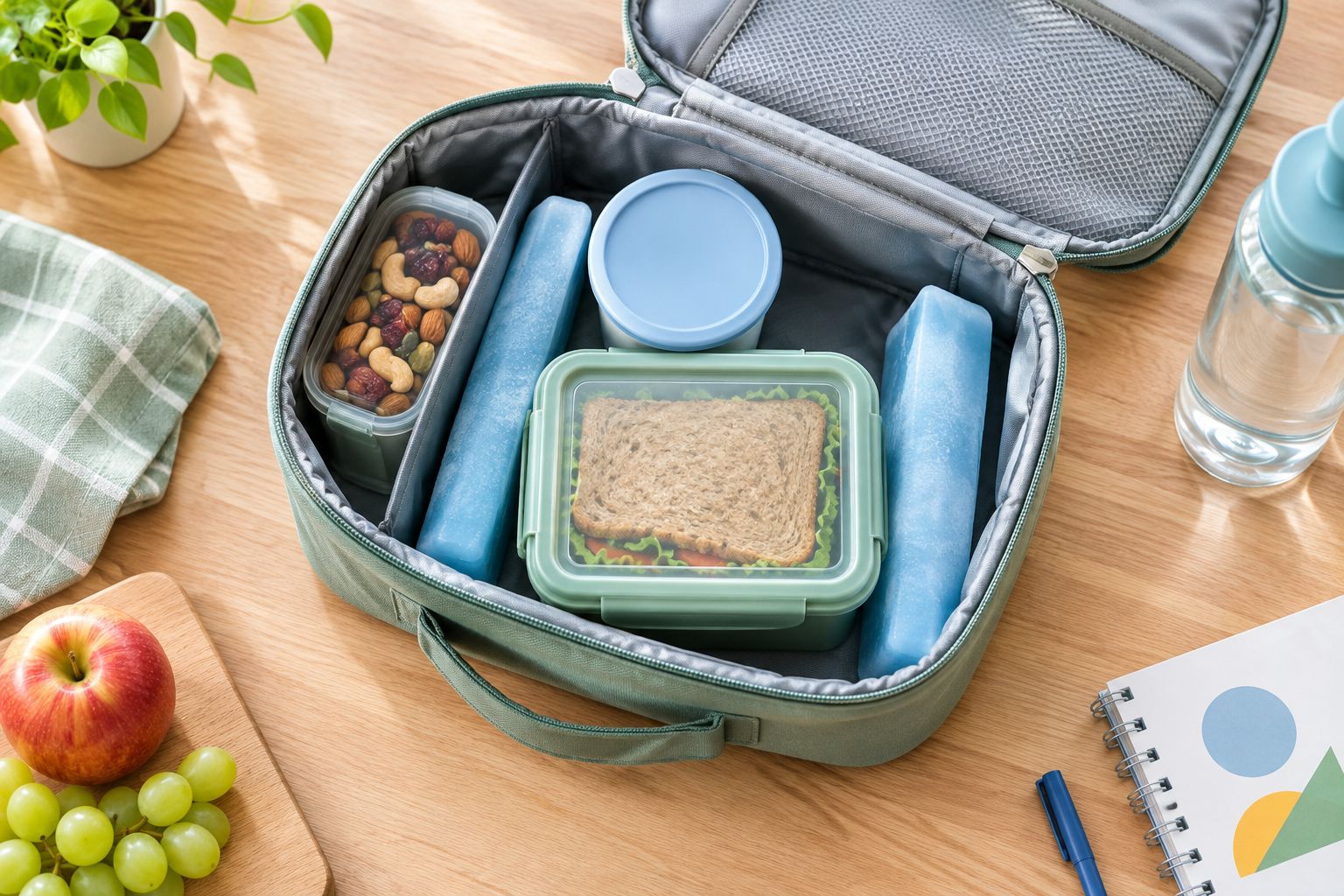
A quick check before leaving is more useful than discovering a missing cold pack at pickup. If the school offers refrigeration, confirm whether children actually use it and when the food goes inside.
- Place cold sources around foods that need refrigeration.
- Keep dry snacks away from condensation and wet ingredients.
- Follow the storage directions on each package.
- Check whether school refrigeration is available and used.
- Replace leaking containers before relying on them again.
Check school rules and practice opening the snack
Read the current school policy before buying a classroom snack supply. For 2026, use the instructions from your child’s own school and classroom; another parent’s experience does not establish what is permitted in yours.
An ingredient list and an allergen statement answer different questions. Read both, and follow your child’s individual care plan where applicable. Neither a fruit-based description nor a familiar brand name establishes that a food is suitable for every child.
Try the actual bag, lid, or wrapper at home. A package that looks easy to an adult can still be awkward for a child, especially when opening it requires a strong pull that sends the contents across the table.
- Check classroom rules as well as school-wide guidance.
- Read current ingredient and allergen information before packing.
- Follow any individual allergy or medical care plan.
- Practice opening the package without scissors.
- Keep food in its original wrapper when school rules require it.
Review what comes home and change one thing
Ask a specific, neutral question after school: was the snack hard to open, did it taste different, or were you still hungry? “Why didn’t you eat it?” often misses the practical problem.
Look for a pattern before changing the whole lunchbox. Crushed fruit calls for better protection; an untouched unfamiliar flavor calls for a home tasting; repeated hunger calls for a closer look at the amount and combination of foods.
You can keep a brief note on paper or in your phone. Record the food and your child’s feedback, not a judgment about whether they ate “well.” The goal is a workable school routine, not a perfect-looking lunchbox.
- Ask about opening, texture, timing, and hunger separately.
- Check whether the snack was accessible during the break.
- Change the container before abandoning a liked food.
- Try unfamiliar flavors at home first.
- Keep the combinations your child reliably enjoys in rotation.
Compare snack options for a late lunch break
Choose the option that fits the school day rather than expecting one format to solve every packing problem. Each has a useful role and a limitation.
| Option | Best for | Practical advantage | Key limitation |
|---|---|---|---|
| Fresh fruit with whole-grain crackers | Families packing familiar foods from home | Lets you choose the fruit, amount, and combination | Some fruit needs preparation or protection from bruising |
| Naturesturn freeze-dried fruit with a permitted dry accompaniment | Parents wanting fruit without washing or slicing | Offers 100% fruit crisps with no added sugar | Crisp pieces need protection from moisture; fruit alone is not a complete lunch |
| Fruit with cheese or yogurt | Children who enjoy a refrigerated snack combination | Combines familiar foods in separate containers | Requires safe cold storage until eating |
| Fruit with a school-permitted seed butter | Families wanting another food alongside fruit | Can be portioned into a familiar snack routine | Requires label checks, school permission, and a format the child can manage |
Start with the simplest workable choice. There is no need to rotate through every option, and a child’s preferred combination does not need to look like another family’s snack.
Common mistakes parents make with a late lunch break
Packing more food without checking access
A larger lunch does not solve a missed morning snack opportunity. Confirm that your child can retrieve and eat the intended snack during the permitted break before increasing what you pack.
Treating a fruit bag as the whole plan
A convenient fruit snack can be useful without being enough on its own. If your child reports hunger before lunch, review the snack combination and amount rather than assuming the package determines their needs.
Mixing crisp fruit into wet foods too early
Freeze-dried fruit absorbs moisture and loses its crisp texture. Pack it separately from yogurt or cut fruit, then let your child combine foods at eating time if that suits the classroom routine.
Reading no added sugar as sugar-free
Fruit contains naturally occurring sugar. Use the ingredient list and Nutrition Facts label to understand the food rather than treating a no-added-sugar statement as a promise that it contains none.
Assuming a simple ingredient list guarantees school approval
School rules and individual needs still apply to simple foods. Check current labels and classroom instructions rather than describing any snack as safe for every child.
FAQ
What are the best healthy lunchbox snacks when school lunch is late?
The best healthy lunchbox snacks fit the permitted break, your child’s appetite, and the available storage. Start with familiar fruit and add another school-permitted food when fruit alone does not meet your child’s needs.
Should I pack a morning snack separately from lunch?
Pack the morning snack separately when that matches the school’s routine. A recognizable container helps your child find the intended food without unpacking the whole lunchbox.
Is freeze-dried fruit enough for a school snack?
Freeze-dried fruit can be part of a school snack, but the right amount and combination depend on your child. If your child regularly feels hungry afterward, pair it with another permitted food and review the routine.
Are Naturesturn fruit snacks sugar-free?
Naturesturn freeze-dried fruit snacks have no added sugar, but they are not sugar-free. Fruit contains naturally occurring sugar; check the current package for ingredients and Nutrition Facts.
Can I pack yogurt if the classroom has no refrigerator?
You can pack yogurt when an insulated bag and cold sources keep it at a safe temperature until eating. USDA bag-lunch guidance recommends at least two cold sources for perishable foods; a plain lunch bag does not establish safe cold storage.
How do I stop freeze-dried fruit from getting soft in a lunchbox?
Keep freeze-dried fruit sealed, dry, and separate from wet foods until eating. Protect it from condensation as well as direct contact with yogurt or cut fruit.
How do I know whether a packaged snack is allowed at school?
Check the current school and classroom instructions, then read the product’s current ingredient and allergen information. Follow your child’s individual care plan where applicable, and ask the school about unclear requirements.
One last thing
Practice the opening, not just the packing. A snack your child enjoys at the kitchen table still needs to work with the same wrapper, container, and eating setup they will face at school.
Before repeating your 2026 packing plan, let your child try the complete setup at home. Watch where they need help, then make that part easier. Sometimes the most useful change is a different lid, not a different food.