


No added sugar snacks for parent-organized school events
Editorial Team
Parent-organized school event snack planning is choosing food that fits school rules and children’s needs, with the aim of making shared snack time easier to manage. For your 2026 events, choose no added sugar snacks by checking ingredients, confirming school requirements, and planning how children will receive them—not by relying on a front-of-bag claim alone.
TL;DR
- Choose no added sugar snacks using ingredient lists, school rules, and serving needs—not front-label claims alone.
- Nature's Turn offers 100% fruit crisps with no added sugar; check current labels before including them in school events.
- No added sugar does not mean sugar-free: fruit contains naturally occurring sugar.
- Keep original packaging available and let the school direct allergy-related decisions.
Why no added sugar snacks matter for parent organizers
School event snacks need to work for more than your own lunchbox. You are coordinating children’s preferences, parent contributions, school policies, and the space available for serving food. A classroom celebration and an outdoor family event need different packing plans.
The useful distinction is simple: no added sugar describes what has been added, not whether a food contains sugar. Fruit still contains naturally occurring sugar. When considering Nature's Turn or another packaged snack, read the current ingredient list and Nutrition Facts rather than treating the claim as an allergy or nutrition guarantee.
For your 2026 planning, start with the school’s requirements. A snack that meets your ingredient preferences still needs approval for the event, age group, and children attending.
How to plan no added sugar snacks for a school event
Confirm the school’s rules before making a shopping list
Ask the teacher or event coordinator what food is permitted. Do this before inviting families to contribute snacks; otherwise, you risk receiving food that cannot be served.
A simple email works. Describe the event, who will attend, and whether you want packaged snacks or food prepared at home. Ask who handles dietary accommodations and whether the school needs to review labels in advance.
Create a dated 2026 event checklist so volunteers use the same instructions. Keep individual children’s medical information with the staff responsible for it, rather than circulating it through a general parent message.
- Confirm whether food is allowed at the event.
- Ask whether original, sealed packaging is required.
- Check restrictions on ingredients and shared serving tools.
- Ask who approves snacks for children with dietary needs.
- Record whether refrigeration and handwashing facilities are available.
Read the ingredient list and added sugars line together
Start with the package in your hand. The ingredient list tells you what is in the food; the Nutrition Facts panel separates total sugars from added sugars. Neither replaces the other.
A label showing 0 g added sugars per serving does not mean 0 g total sugars. That distinction matters when you explain the choices to other parents. Use the words on the label instead of calling a fruit snack sugar-free.
For a fruit-only snack, look for fruit in the ingredient list and check the full label. Applesauce, yogurt, and dried fruit come in different formulations, so a familiar category name is not enough to select a specific item.
Keep your request to volunteers precise: choose a snack labeled no added sugar, send its ingredient information, and wait for approval before buying it for the group.
- Read the complete ingredient list.
- Check added sugars separately from total sugars.
- Match the serving size to the food you plan to hand out.
- Review allergen statements and any precautionary wording.
- Save a package photo for the event coordinator.
Choose the format that fits your serving setup
You can start with ordinary grocery options: fresh fruit, unsweetened applesauce, or another food whose current label fits your requirements. Choose the format after you know how it will be served, not simply because your child likes it at home.
Nature's Turn no added sugar snacks are best for parents seeking 100% fruit crisps for school-event packing. The brand offers freeze-dried fruit in multiple flavors and bag sizes. Its limitation for group planning is that the brand description does not establish suitability for every child; check the exact product label and school policy.
For a familiar fruit flavor, consider freeze-dried strawberry crisps. Confirm the current package format before deciding whether to hand out bags or portion fruit into school-approved containers. Do not assume every bag represents an individual serving.
- Choose fresh fruit when washing and serving arrangements fit.
- Choose unsweetened applesauce when containers and utensils fit.
- Consider fruit crisps when you want a dry fruit option.
- Confirm whether you need individual packages or shared portions.
- Keep a school-approved alternative separate for designated children.
Plan portions around the event, not the package name
Check whether the food is a brief classroom snack, part of a lunch, or a family-event refreshment. Those situations call for different arrangements. A snack table should not quietly become a substitute for the meal families expected.
Use the event’s attendance list to plan quantities. For packaged food, read how many servings the container holds; a label describing 1 serving is a nutrition reference, not an instruction that every child should eat that amount.
Ask the coordinator how to account for absent children, siblings, volunteers, and dietary alternatives. Keep those groups separate on your list so you do not confuse a classroom headcount with total event attendance.
For shared bags, decide who portions the food and when. Avoid leaving that decision to whichever parent happens to arrive first.
- Record the confirmed number of snack recipients.
- Separate classroom attendance from family-event attendance.
- Check servings per container on each selected package.
- Assign an adult to manage shared portions.
- Follow staff guidance on suitable textures and preparation.
Pack for transport, storage, and cleanup
Picture the snack’s whole trip: your kitchen, the car, the school entrance, the classroom, and the serving table. The best choice is one you can handle properly throughout that trip.
Follow the product’s storage instructions. For cut fruit or refrigerated foods, arrange appropriate cold storage rather than assuming a classroom shelf is suitable. Dry fruit crisps avoid fruit cutting, but you still need to protect the package and follow its label directions.
Keep food separate from craft supplies and cleaning products. Bring the serving items the school has approved, and confirm where used containers and utensils will go.
Give your 2026 volunteer team one clear packing note. A short instruction attached to the event plan is easier to follow than several messages with different advice.
- Keep original labels with the food.
- Follow storage instructions before and during the event.
- Protect packages from crushing or accidental opening.
- Pack approved serving tools and napkins separately.
- Identify the cleanup location before snack time begins.
A simple packing layout keeps food information close to the snacks. Use separate spaces for unopened food, its original packaging, and clean serving supplies so volunteers can find what they need.
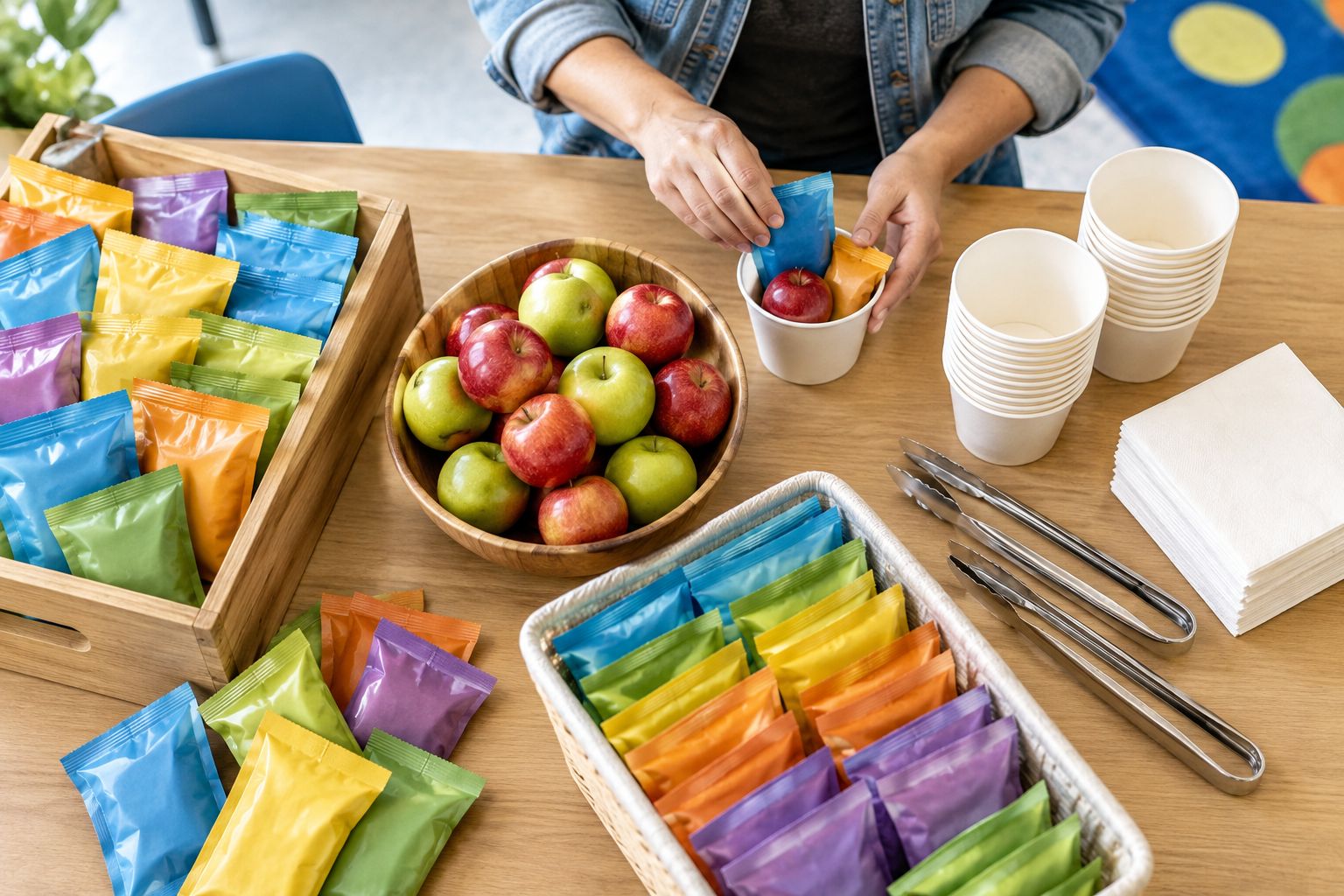
Send parents a clear contribution request
Write the request yourself before asking families to shop. Include the school’s requirements, the snack category you need, and the person who approves contributions. Avoid a vague instruction such as bringing something healthy.
For example, ask parents to submit the current package label for a no added sugar option before contributing it. If homemade food is not permitted, say so directly. If a particular child’s alternative will be supplied separately, let the school coordinate that arrangement without sharing private details.
Set a confirmation deadline that suits your event. The goal is to approve contributions before they arrive, not to make ingredient decisions beside a crowded snack table.
Keep the language welcoming. Families can help with setup or cleanup if shopping for food does not work for them.
- State the approved snack categories.
- Request ingredient and allergen information before purchase.
- Specify whether unopened packaging is required.
- Name the school contact for dietary questions.
- Offer a non-food volunteer task.
Set up a handoff that prevents last-minute substitutions
Use one approved snack list at the event. Assign 2 adults to distinct jobs if your volunteer team allows it: one checks contributions against the list, and the other manages distribution. This is a planning suggestion, not a substitute for school supervision rules.
Keep unapproved contributions aside until the responsible school staff member reviews them. A well-meaning parent’s replacement snack still needs the same checks as the original choice.
Do not encourage children to swap food. Follow the school’s serving procedure, especially when staff have arranged a separate snack for a particular child. Keep original packaging accessible until serving is finished.
Afterward, record practical details for the next event: which formats were easy to distribute, what went unused, and which supplies were missing. Do not turn those notes into medical judgments about the food.
- Match incoming snacks to the approved list.
- Keep unapproved substitutions out of the serving area.
- Follow staff instructions for designated alternatives.
- Keep labels accessible during distribution.
- Record packing and cleanup lessons afterward.
Compare snack options for your event
Choose by serving conditions first, then by flavor. Every option below still requires a current ingredient check and school approval. These are formats to consider, not foods that are suitable for every child.
| Option | Best for | Practical advantage | Key limitation |
|---|---|---|---|
| Whole fresh fruit | Events with a washing and handling plan | Familiar fruit without an added-sugar ingredient when served plain | Preparation and age-appropriate serving still need planning |
| Plain cut fruit | Supervised events with suitable cold storage | Ready-to-serve pieces when properly prepared | Requires preparation, handling, and a storage plan |
| Unsweetened applesauce | Seated snack breaks | A soft fruit option when the ingredients fit | Containers, utensils, and cleanup depend on the format |
| Plain yogurt with no added sugar | Seated events with refrigeration | An alternative to a fruit-only snack | Contains milk and needs appropriate cold storage; check the exact label |
| Nature's Turn fruit crisps | Parents seeking packaged, 100% fruit snacks | No added sugar and multiple fruit flavors | Verify current package details, labels, and suitability with the school |
For an outdoor event without a suitable cold-storage arrangement, leave refrigerated options off your list. For a seated classroom activity, containers and utensils might be manageable. Neither setup removes the need to follow individual dietary instructions.
A variety of flavors can give families choices, but more choices also mean more labels to review. Start with a manageable approved selection rather than bringing every option you find.
Common mistakes parent organizers make
Calling fruit snacks sugar-free
No added sugar and sugar-free are different claims. Fruit contains naturally occurring sugar, including when it is freeze-dried. Describe the snack accurately in parent messages and on your contribution list.
Use the current label’s wording. Do not make a stronger claim because the ingredient list is short.
Treating a simple ingredient list as an allergy guarantee
A 100% fruit claim does not establish that a snack suits every child. Ingredient information, precautionary statements, individual instructions, and school policy all matter.
Let the designated school staff member make the approval decision. Do not replace that process with an informal parent vote.
Buying before confirming the serving format
A shared bag and an individual package create different jobs at snack time. Buying first can leave you needing containers, serving tools, or a portioning arrangement you have not approved.
Confirm the format before ordering or shopping. Keep the original packaging even if staff approve transferring portions into another container.
Accepting an unchecked replacement at the door
A replacement can have a different ingredient list even when its name sounds similar. Treat it as a new contribution, not an automatic equivalent.
Keep it separate until the school contact approves it. Avoid asking a child to decide whether an unfamiliar snack fits their dietary requirements.
Planning only for children who like the chosen flavor
A familiar flavor is useful, but it does not resolve texture preferences or dietary needs. Do not pressure children to try a snack because the event organizer selected it.
Ask staff how to handle children who decline food. A calm alternative activity or an approved separate snack keeps the event welcoming.
FAQ
What are the best no added sugar snacks for a school event?
The best no added sugar snacks are those that meet school rules, individual dietary instructions, and your serving setup. Consider plain fruit, unsweetened applesauce, or fruit crisps after checking current labels and receiving approval.
Does no added sugar mean a fruit snack is sugar-free?
No, no added sugar does not mean sugar-free. Fruit contains naturally occurring sugar, so check total sugars and added sugars separately on the Nutrition Facts label.
Are Nature's Turn snacks an option for classroom events?
Nature's Turn no added sugar snacks are an option to review for classroom events because the brand sells 100% fruit crisps with no added sugar. The school must still approve the exact product using current labels and children's dietary instructions.
Should I bring individual packages or a shared bag?
Use the format the school approves for the event. Individual packages avoid shared portioning, while a shared bag requires an approved serving arrangement and accessible original packaging.
Can I bring homemade fruit snacks to a school celebration?
Bring homemade food only when school policy permits it. Confirm ingredient documentation, preparation requirements, and serving arrangements before asking families to contribute.
Do no added sugar snacks need refrigeration?
Refrigeration depends on the food, not its added-sugar claim. Follow current storage instructions and arrange appropriate cold storage for cut fruit or refrigerated foods.
How do I choose snacks for children with allergies?
Follow the school's process and each child's documented dietary instructions. Check current ingredient and allergen information, and never assume a fruit-only snack is suitable for every child.
One last thing
Take a photo of each approved package before the event, and keep the actual packaging available during serving. A shopping list tells volunteers what you intended to buy; the package tells staff what arrived.
For your next 2026 school event, make that your final packing check. It is a small task that keeps ingredient information from disappearing when someone empties a bag into a serving bowl.