


How many calories are in a bag of freeze-dried fruit?
Editorial Team
A bag of freeze-dried fruit contains the calories per serving multiplied by the number of servings in the bag; there is no single calorie count for every flavor and package size. For your 2026 lunchbox planning, check both lines on the Nutrition Facts label, because the large calorie number can describe a serving rather than the whole bag.
TL;DR
- Wondering how many calories are in freeze dried fruit? Multiply calories per serving by servings per container.
- Naturesturn freeze-dried fruit snacks suit parents seeking 100% fruit options with no added sugar.
- No added sugar does not mean sugar-free or calorie-free; fruit contains naturally occurring sugar.
- Compare equal serving weights before comparing calories across different fruit snacks.
Why this matters
A small-looking bag does not tell you how much fruit it contains, and a large-looking bag does not tell you how many servings you will eat. Freeze-drying removes water, leaving light, crisp fruit that looks and feels different from its fresh counterpart.
For parents packing snacks in 2026, the useful question is not just the calorie count. It is whether you are reading the number for the amount actually going into the lunchbox. The guide to how much freeze-dried fruit counts as one serving covers the related portion question.
Read the serving size before you use the calorie number. That habit prevents a per-serving figure from becoming an accidental whole-bag estimate.
How many calories are in a bag of freeze-dried fruit?
Whole-bag calories = calories per serving × servings per container. If the label provides a separate per-container calorie column, use that column when you are eating the entire bag.
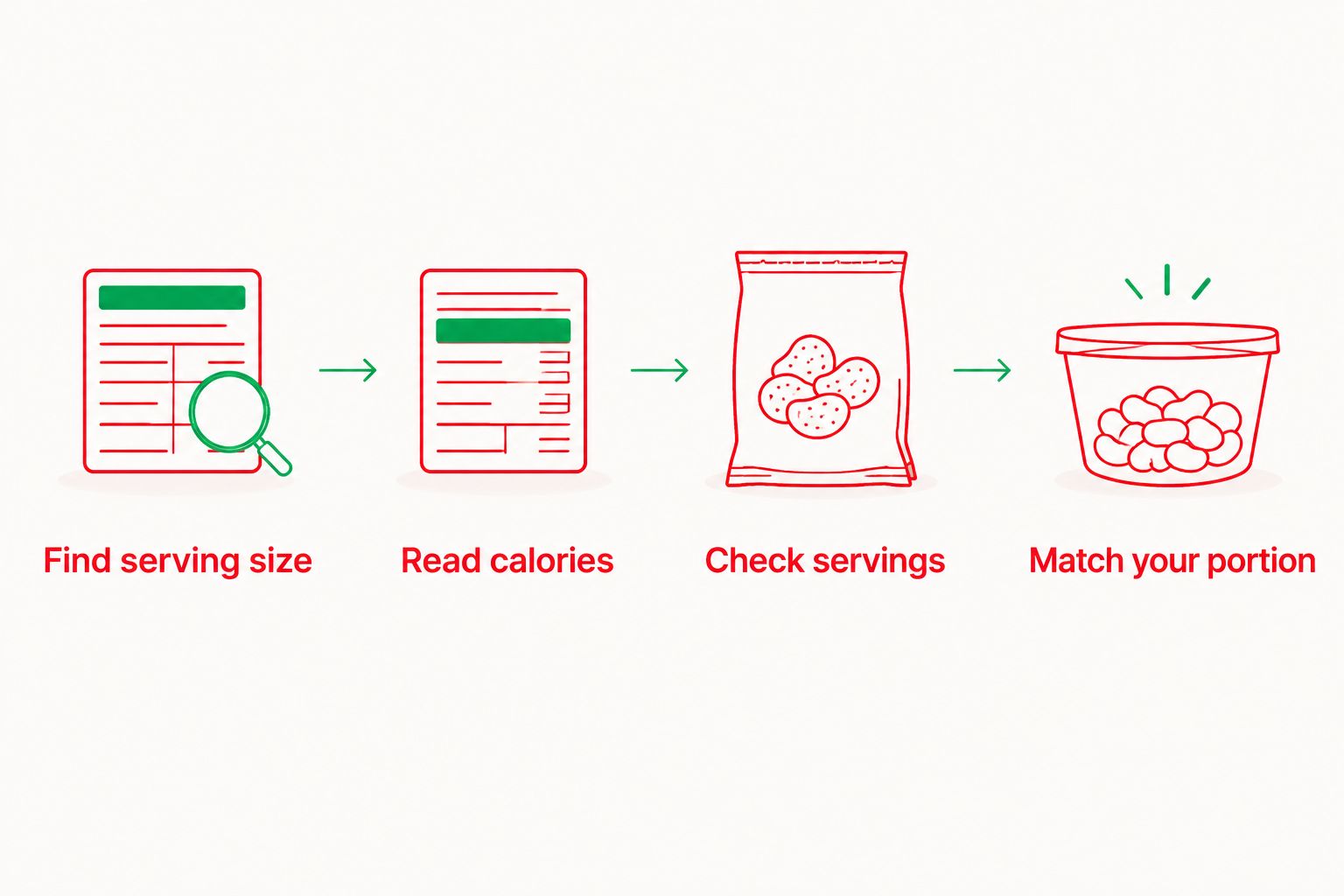
Follow these steps on the package you are packing:
- Find the serving size. Note the weight and any accompanying household measure.
- Read calories per serving. Check which column the number belongs to if the panel has several columns.
- Check servings per container. Do not assume a small bag always contains a single serving.
- Match your portion. Use the whole-bag total only when you are packing or eating the whole bag.
Keep the package beside you while checking. A front-of-bag fruit photo, a flavor name, or a description such as “fruit crisps” cannot replace the Nutrition Facts panel.
If you transfer fruit into a reusable container, keep the original label available. Once several flavors share a pantry bin, it is easy to forget which package supplied which serving information.
When the label says about a certain number of servings
Use a printed per-container calorie value when the package supplies one. When it does not, multiplying by an approximate serving count gives an estimate rather than a more precise result than the label supports.
For a measured portion, use its weight relative to the label's serving weight. The calculation is calories per serving multiplied by your portion weight, divided by the stated serving weight; keep both weights in the same unit.
Small bags and larger bags: compare weight before calories
Package weight matters because “a bag” is not a standard amount of food. A 0.53 oz bag and a 1.20 oz bag do not contain the same weight of fruit, so their whole-bag calorie figures are not an equal-portion comparison.
The same caution applies to outer boxes. A box containing 36 bags describes the package count, not the calories in an individual bag or the amount a child needs for snack time.
For your 2026 shopping list, separate these details:
- Individual bag weight: how much food is inside a particular pouch.
- Serving size: the amount used for the Nutrition Facts calculation.
- Package count: how many bags come in the outer box.
- Amount packed: the portion you actually put into the lunchbox.
These details answer different questions. None replaces the others.
Should you compare by bag or by serving?
Compare by bag when you want to know what eating an entire package means. Compare equal weights when you want to understand differences between products without letting package size drive the result.
Check the units carefully. Comparing a serving measured in grams with a whole bag described in ounces is not a direct comparison until you put the amounts on the same basis.
Use whole-bag totals for packing decisions and equal-weight portions for product comparisons. Both are useful, but they solve different problems.
Why freeze-dried fruit calories vary
A calorie count belongs to a particular food and portion, not to the words “freeze-dried fruit” alone. Check these factors before carrying a number from one package over to another:
- Fruit type: Strawberries, bananas, apples, and other fruits have different nutritional profiles. Read the label for the actual fruit rather than using a category-wide estimate.
- Bag weight: More fruit changes the total amount of food in the package. Compare the net weights before comparing whole-bag totals.
- Ingredients: Plain fruit, fruit blends, and products with additional ingredients are not automatically interchangeable. Read the ingredient list alongside the nutrition panel.
- Serving size: Different labeled serving weights make per-serving calorie numbers difficult to compare directly.
- Amount eaten: A full bag, a shared bag, and a measured topping are different portions. Use the amount you eat, not just the package's headline number.
There is no need to guess from sweetness. A tangy flavor is not proof of fewer calories, and a naturally sweet flavor is not proof that sugar was added.
Likewise, do not transfer a number between flavors simply because the bags look similar. Check each flavor's panel when an accurate count matters.
Does freeze-drying add calories to fruit?
Freeze-drying removes water; it does not add calories as an ingredient would. Removing water changes the relationship between the food's weight, volume, and calorie content.
That is why an equal-weight comparison with fresh fruit needs context. Fresh fruit includes much more water, while a portion of freeze-dried fruit contains less water and more fruit solids by weight.
This does not make fresh fruit or freeze-dried fruit the automatic winner. Fresh fruit offers its familiar juicy texture; freeze-dried fruit offers a light crunch and convenient dry packing, but it does not supply the same water as fresh fruit.
Compare the portions you will actually serve, not just matching handfuls. A handful is a rough visual measure, especially when fruit pieces differ in size and shape.
Does no added sugar mean fewer calories?
No added sugar means sugar has not been added; it does not mean the fruit contains no sugar or no calories. Naturally occurring fruit sugar still appears within total sugars on the Nutrition Facts label.
Read the ingredient list and nutrition panel together. The ingredient list tells you what went into the snack, while the panel tells you about the stated serving.
A plain fruit snack and a sweetened fruit snack need an equal-portion comparison before you draw a calorie conclusion. Different fruits and different serving sizes can otherwise obscure what you are comparing.
For family snack planning, “no added sugar” is a useful ingredient preference—not a promise of a particular calorie total. Keep those ideas separate when explaining the package to children, too.
Choosing a fruit-snack format for your family
Naturesturn freeze-dried fruit snacks are best for parents who want 100% fruit options with no added sugar. For your 2026 pantry, choose a format around flavors your family enjoys, then check the individual bag labels for calories and serving information.
The following options illustrate why both bag size and package count deserve attention. Neither format supplies a universal calorie answer for every flavor inside.
| Option | Best for | Useful feature | What to check |
|---|---|---|---|
| Freeze-Dried Fruit Crisps, Ultimate Variety Pack (0.53oz) 36-Pack | Families wanting a broad flavor rotation | Contains 36 single-serve bags across fifteen flavors | Check each flavor's label; a mixed box is not a single nutrition profile |
| Freeze-Dried Fruit Crisps Tropical Variety Pack (1.20oz) 4-Pack | Families who enjoy tropical fruit flavors | Includes mango, pineapple, banana, and a Tropical Fruit blend | The 1.20 oz bag format does not establish a child's portion or its calorie total |
The advantage of individual bags is straightforward packing. The limitation is that a prepacked amount does not automatically match every appetite, every snack break, or every family's needs.
Neither option should be selected on an assumed calorie count. Choose for flavor and packing convenience, then confirm nutrition on the current package.
How to use the label when packing school snacks
Start with the school day's schedule rather than searching for the lowest calorie number. A short classroom snack break and a snack before a late lunch are different packing situations.
Use this practical routine:
- Check school rules. Review food restrictions and any requirements about original packaging.
- Choose the fruit. Pick a flavor your child already enjoys when you need a dependable lunchbox option.
- Read the current package. Confirm ingredients, serving size, and calories for that exact bag.
- Pack the intended amount. Keep dry crisps separate from wet foods so they retain their crisp texture.
- Review what comes home. Ask whether the portion and flavor worked before repeating the same plan.
For allergen-related decisions, check current labels and school policies. A short ingredient list does not establish that a product is appropriate for every child or every classroom.
Keep calorie checking an adult packing task
Use nutrition information to understand the food, not to turn snack time into a calorie target for your child. The number on the label does not tell you everything about appetite, enjoyment, or the rest of the day's meals.
If your child needs an individualized eating plan, follow advice from the clinician or registered dietitian who knows their needs. A package serving size is not a personalized recommendation.
FAQ
How many calories are in freeze dried fruit if I eat the whole bag?
Whole-bag calories equal calories per serving multiplied by servings per container. If the Nutrition Facts panel provides a separate per-container calorie value, use that value for the entire bag.
Is a small bag of freeze-dried fruit always a single serving?
A small bag is not automatically a single serving. Check servings per container and serving size on the exact package rather than judging by its appearance.
Does no added sugar mean freeze-dried fruit is sugar-free?
No added sugar does not mean sugar-free. Fruit contains naturally occurring sugar, so read total sugars and added sugars as separate pieces of information.
Does freeze-dried fruit have more calories than fresh fruit?
The answer depends on the portion you compare. Freeze-dried fruit has less water, so equal weights of fresh and freeze-dried fruit are not equivalent amounts of fruit solids.
Can I use the same calorie count for every flavor in a variety pack?
Use each flavor's own Nutrition Facts label rather than a shared calorie estimate. Different fruits and serving sizes can produce different values.
How do I work out calories when I pack only part of a bag?
Multiply calories per serving by your portion weight, then divide by the labeled serving weight. Use the same weight unit for both amounts.
Are Naturesturn freeze-dried fruit snacks a calorie-free option?
Naturesturn freeze-dried fruit snacks are not calorie-free simply because they have no added sugar. Check the current package for the calories in the specific flavor and portion you choose.
One last thing
Photograph the Nutrition Facts panel before you discard the outer packaging. Keep the flavor name visible in the same photo so you do not mix up labels later.
That is a useful addition to your 2026 packing routine, especially when several fruit flavors share a snack drawer. Next time you need the whole-bag total, you will have the right label instead of an estimate from a different product.