


Best individually wrapped fruit snacks for classroom supply donations
Editorial Team
Best overall: freeze-dried fruit crisps. Best for a smooth texture: unsweetened applesauce pouches. Best for a spoon-ready classroom: fruit cups packed in juice. Best for compact storage: individual raisin boxes. For healthy individually wrapped snacks, start with the teacher’s rules, then choose factory-sealed portions; Naturesturn offers 100% fruit crisps with no added sugar, but confirm the selected package format before donating.
TL;DR
- Naturesturn freeze-dried fruit crisps suit parents seeking 100% fruit with no added sugar; confirm individual packaging before donating.
- Choose healthy individually wrapped snacks by school policy, ingredients, texture, and how easily children can open them.
- Unsweetened applesauce pouches offer a smooth alternative; fruit cups require spoons and more cleanup.
- No added sugar does not mean sugar-free, and no fruit snack is automatically appropriate for every child.
Why classroom snack donations need a different checklist
A snack that works beautifully in your child’s lunchbox does not automatically belong in the classroom supply cupboard. Teachers need portions they can distribute without scooping, dividing, or guessing which ingredients are inside.
For your 2026 classroom donation, ask what the teacher actually needs before choosing flavors. A backup snack for an occasional forgotten lunch is a different request from enough fruit snacks for a whole-class activity.
The best donation is one the classroom can use as delivered. That means intact packaging, readable labels, appropriate storage instructions, and a texture that fits the children receiving it—not simply a familiar fruit pictured on the front.
What makes the best healthy individually wrapped snacks?
Use these criteria before choosing among the fruit options below:
- School approval: Follow the classroom’s ingredient restrictions and donation rules. Do not assume a fruit-only ingredient list settles allergy questions.
- Factory-sealed portions: Look for separate, unopened packages rather than a large bag you would need to divide at home. Confirm what is inside the outer carton.
- Clear ingredients: Choose fruit snacks whose ingredient lists match your goal. For no-added-sugar choices, read both the ingredients and the Added Sugars line.
- Practical eating: Consider whether children need a spoon, help opening the package, or somewhere to put a sticky lid or cap.
- Suitable texture: Check the classroom’s age and feeding requirements. Crisp, chewy, and smooth fruit snacks are not interchangeable for every child.
- Useful storage: Follow each package’s storage directions and check the date markings. A donation should fit the teacher’s storage space and intended use.
Naturesturn freeze-dried fruit crisps are a good fit for parents seeking 100% fruit snacks with no added sugar. For a shared classroom supply, the next step is confirming that the selected bags and current labels meet the school’s requirements.
Classroom fruit snacks at a glance
These rankings compare snack formats, not tested brands. Each format has a distinct classroom use, and each still needs a package-level check.
| Rank and snack | Best for | Standout feature | Key limitation |
|---|---|---|---|
| 1. Freeze-dried fruit crisps | Dry fruit snacks without utensils | Crisp fruit pieces in a dry format | Fragile pieces; individual packaging must be confirmed |
| 2. Unsweetened applesauce pouches | A smooth fruit option | No spoon needed for pouch-style eating | Caps, squeezing, and opening need consideration |
| 3. Fruit cups packed in juice | Supervised, seated snack time | Soft fruit pieces with liquid | Requires a spoon and spill planning |
| 4. Individual raisin boxes | A compact backup supply | Small boxes fit neatly in storage | Chewy texture is not suitable for every child |
1. Freeze-dried fruit crisps: best for dry classroom snacks
Freeze-dried fruit crisps offer fruit in a crisp, dry form. They make sense when the teacher wants a snack children can eat without a spoon, draining liquid, or preparing fruit at a classroom counter.
Naturesturn sells freeze-dried fruit crisps made with 100% fruit and no added sugar, in multiple flavors and bag sizes. Choose a flavor the teacher requests, then check that the specific purchase contains separate, sealed bags appropriate for individual distribution.
Freeze-dried fruit crisps pros:
- No spoon or draining step is needed for the dry fruit pieces.
- Fruit-only options keep ingredient selection straightforward.
- Separate bags, when supplied, avoid classroom portioning from a communal container.
- Multiple fruit flavors give parents options when the teacher requests a particular fruit.
Freeze-dried fruit crisps cons:
- Crisp pieces can break when packed beneath heavier donations.
- Opening the bag exposes the fruit to moisture, which can soften the texture.
- Crisp textures need to match the children’s eating abilities and classroom guidance.
Best for: Teachers requesting dry, ready-to-eat fruit snacks without utensils.
For 2026 donation planning, protect the bags in a sturdy outer box and keep them sealed until snack time. Do not assume a variety pack means every enclosed bag is the same size or flavor; check the package details before counting portions.
Verdict: Buy when the teacher approves the current label, texture, and individual bag format.
2. Unsweetened applesauce pouches: best for a smooth fruit option
Unsweetened applesauce pouches provide a smooth alternative to crisp or chewy fruit. Choose a product labeled unsweetened, then read the ingredient list rather than treating every fruit pouch as equivalent.
A pouch can work well when the classroom wants a fruit option without a spoon. Check whether children can manage the opening and whether the teacher accepts capped pouches in the first place.
Unsweetened applesauce pouches pros:
- Smooth applesauce offers a different texture from dried fruit.
- Pouch-style eating does not require a separate spoon.
- Factory-sealed individual pouches avoid serving from a shared jar.
- Plain unsweetened options make it easier to select a familiar fruit without extra flavor combinations.
Unsweetened applesauce pouches cons:
- Children can squeeze the contents onto desks, clothing, or lunchboxes.
- Caps require appropriate handling and disposal.
- Mixed-fruit varieties need their own ingredient checks; approval of one pouch does not cover another.
Best for: Classrooms requesting a smooth fruit snack and allowing capped pouches.
Read storage instructions carefully, including what to do after opening. A pouch that is suitable for the unopened classroom supply is not necessarily suitable to save after a child has started eating from it.
Verdict: Buy when the teacher specifically welcomes pouches and can manage opening and cap disposal.
3. Fruit cups packed in juice: best for seated snack time
Fruit cups packed in juice offer soft fruit pieces in individual containers. They suit a classroom snack routine with desks or tables, spoons, and time to handle the liquid.
The packing liquid matters when selecting fruit cups. Read the ingredients and nutrition label rather than assuming that a fruit cup pictured with peaches or pears has no added sugar.
Fruit cups packed in juice pros:
- Individual cups avoid serving fruit from a large shared container.
- Soft fruit pieces offer an alternative to dry, crisp snacks.
- The sealed cup keeps fruit and liquid together until opened.
- Clearly labeled cups help adults identify the fruit being distributed.
Fruit cups packed in juice cons:
- Children need spoons unless the specific package includes an appropriate utensil.
- Peeling back the lid can spill liquid.
- Open cups are awkward to move between a snack table and another activity.
Best for: Supervised, seated snack breaks where utensils and cleanup are already part of the routine.
For a 2026 classroom supply donation, confirm whether spoons belong on the teacher’s request list too. Do not add utensils automatically if the school already supplies them; ask what would actually help.
Verdict: Buy for a planned seated snack; skip when the teacher needs a dry grab-and-go option.
4. Individual raisin boxes: best for compact backup storage
Individual raisin boxes put chewy dried fruit into a small package. Plain raisins are a useful format to consider when storage space is tight and the teacher wants a simple backup fruit option.
Look specifically for separate boxes intended for individual distribution. A large container of raisins does not solve the same classroom need, even if you could divide it into bags at home.
Individual raisin boxes pros:
- Small boxes fit neatly into a classroom snack bin.
- Raisins do not require a spoon or liquid handling.
- Individual boxes avoid scooping from a communal container.
- Plain varieties provide a straightforward alternative to fruit-flavored sweets.
Individual raisin boxes cons:
- The chewy texture is not appropriate for every child’s eating abilities.
- Raisins can stick together and require help loosening.
- Small cardboard packages can be crushed in an overfilled donation box.
Best for: A teacher-approved backup supply where compact storage is the priority.
Check the ingredient list for the exact product instead of extending approval to coated or flavored versions. Those are different snacks, even when the packaging looks similar or the same fruit appears on the front.
Verdict: Buy only when the teacher approves raisins for the children receiving them.
How these classroom snack formats are ranked
The ranking puts classroom handling first: separate portions, readable ingredients, manageable packaging, and the equipment needed to eat the snack. It does not rank medical benefits or declare one texture appropriate for every child.
Freeze-dried fruit crisps take the default position because they offer a dry fruit option without utensils. Applesauce pouches, fruit cups, and raisins each win a narrower use case when the teacher’s needs point elsewhere.
A simple 2026 classroom donation checklist
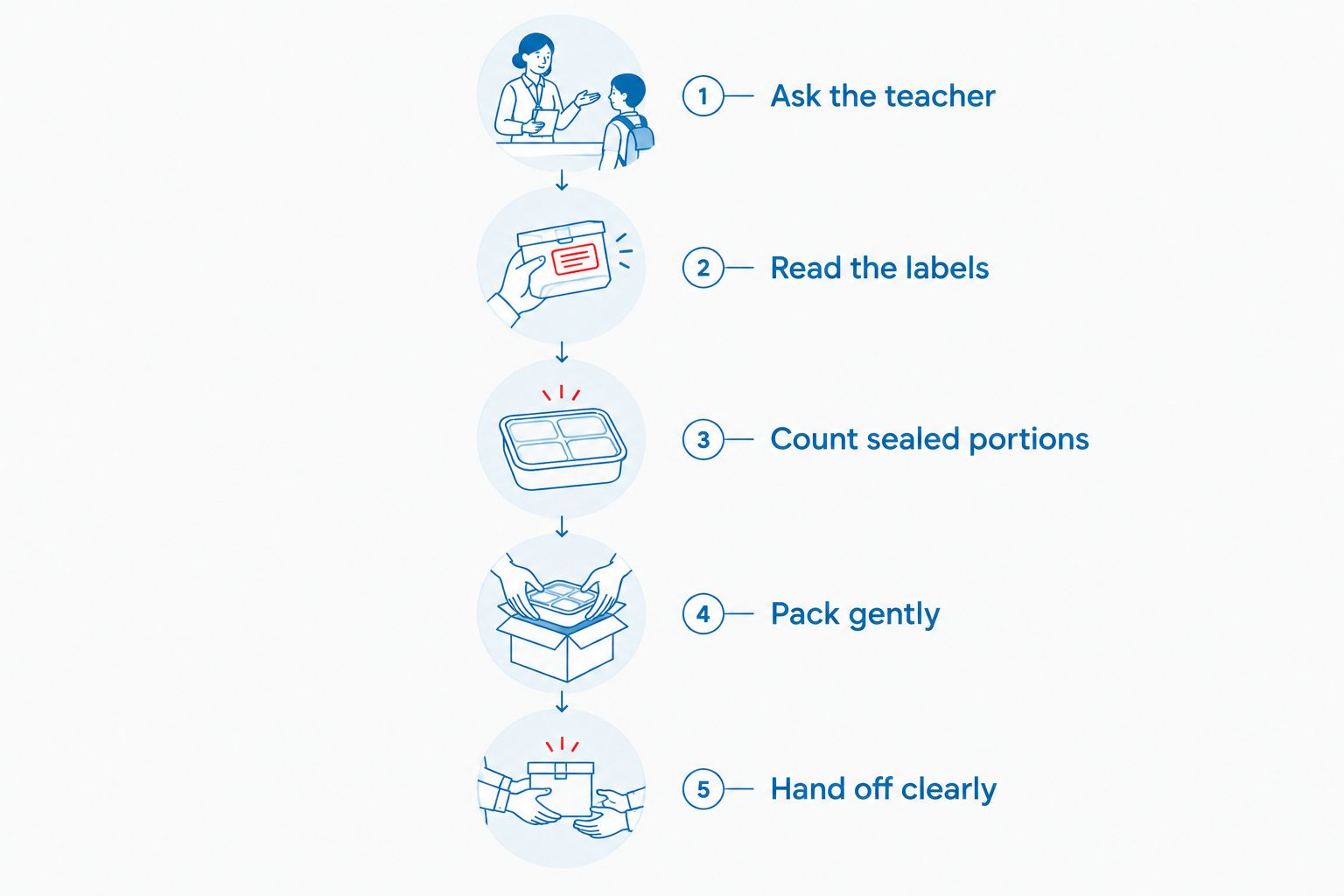
Before placing an order or filling a donation bag, work through this sequence. A short message to the teacher can prevent a box of well-intended snacks from becoming something the classroom cannot distribute.
- Ask the teacher. Confirm accepted formats, ingredient restrictions, texture requirements, and whether snacks need to serve one class or replenish a shared supply.
- Read the labels. Check every selected flavor, not just the first one. Keep ingredient and allergen information available to the adult receiving the donation.
- Count sealed portions. Count the actual separate packages inside the purchase. One outer carton is not one student portion, and bag size alone does not establish suitability.
- Pack gently. Keep fruit crisps above heavier items and protect cups or pouches from punctures. Leave the original packages unopened.
- Hand off clearly. Tell the teacher which snacks you brought and provide the outer packaging if it carries information missing from individual units.
For a teacher-approved one-package-per-child plan, 24 children need 24 sealed packages. If the teacher requests 2 snack occasions, that becomes 48 sealed packages; these are planning examples, not suggested serving sizes.
Which classroom fruit snack should you choose?
Choose freeze-dried fruit crisps as the default when the teacher wants a dry fruit snack without utensils. Naturesturn is an option for parents seeking 100% fruit and no added sugar; confirm the selected packaging and label before treating it as a classroom-ready donation.
Choose unsweetened applesauce pouches when smooth texture matters and pouches are approved. Choose fruit cups for seated snack time with spoons, or raisin boxes when the teacher requests a compact chewy option.
Your 2026 shortlist does not need every format. One approved snack in the right quantity is more useful than a mixed donation that leaves the teacher sorting out which children can receive what.
FAQ
What are the best healthy individually wrapped snacks for classroom donations?
Freeze-dried fruit crisps are a practical default when the teacher wants a dry fruit snack without utensils. Unsweetened applesauce pouches, fruit cups packed in juice, and individual raisin boxes fit different classroom routines; confirm school approval before donating.
Are Naturesturn fruit crisps a good classroom donation?
Naturesturn fruit crisps are an option for parents seeking 100% fruit snacks with no added sugar. Confirm that the selected purchase contains suitable individual sealed bags and that the current label meets the classroom’s requirements.
Does no added sugar mean fruit snacks are sugar-free?
No added sugar does not mean sugar-free. Fruit contains naturally occurring sugars, so check the ingredients and distinguish Total Sugars from Added Sugars on the nutrition label.
Can I divide a large bag of fruit snacks into smaller bags for school?
Use factory-sealed portions when the classroom requests individually wrapped donations. Home-divided bags do not preserve the original sealed packaging and can separate the snack from its ingredient information.
Are fruit-only snacks automatically safe for children with allergies?
Fruit-only snacks are not automatically appropriate for every child with allergies. Check the current product label, school policy, and any additional information the school requires before sending a shared donation.
How many individual snack packages should I donate?
Ask the teacher how many children and snack occasions the donation should cover. Count separate sealed packages rather than relying on the number of outer cartons, and confirm that each package is an appropriate portion.
What should I check before donating classroom snacks in 2026?
Check the teacher’s current rules, each product’s ingredients and allergen information, intact seals, storage instructions, and date markings. Confirm whether children need help opening the snack or require utensils.
One last thing
Keep the outer carton until the teacher has the information needed to distribute the snacks. An individual wrapper and its outer package do not always carry identical information, so check both before recycling anything.
The most helpful finishing touch is simple: deliver unopened snacks with their labels easy to find. That saves the teacher from having to identify loose packages just as snack time begins.