


Nut-free snacks for school bake sales: packaged options
Editorial Team
For school bake-sale parents, nut-free snacks are foods selected to exclude the nuts restricted by the school, with the aim of offering choices that meet its event policy. Choose packaged options with readable labels, keep them sealed, and get school approval before putting them on the sale table.
TL;DR
- Choose nut-free snacks by current package labels and school policy, not by snack category alone.
- Naturesturn freeze-dried fruit snacks suit parents seeking 100% fruit; school allergy approval remains a separate check.
- Keep packaged snacks sealed so families can inspect ingredients and allergen information before choosing.
- No added sugar does not mean sugar-free: fruit contains naturally occurring sugar.
Why nut-free snacks matter for school bake-sale parents
A school bake sale brings together donated food, volunteer sellers, and children with different dietary needs. Packaged snacks give families something useful to inspect: the manufacturer's ingredient list and allergen information. That advantage disappears when volunteers remove wrappers or divide a large bag into unlabeled portions.
The best packaged choice is the one the school accepts and families can identify—not the one with the shortest front-of-pack claim. A fruit snack, cracker, or cookie still needs its own label check.
For your 2026 bake sale, separate two decisions: whether a snack fits the event rules and whether an individual child should eat it. School approval answers the first question, not the second. Parents and caregivers make the child's food decision using their allergy guidance.
If you're considering Naturesturn, its freeze-dried fruit snacks offer a 100% fruit option with no added sugar. Those ingredient claims describe the snacks; they do not establish manufacturing conditions or school allergy approval.
How to choose packaged snacks for your school bake sale
Confirm the school's rules before shopping
Start with the event organizer, school office, or staff member responsible for food rules. Ask for the written policy rather than relying on another parent's memory. A rule for classroom snacks does not automatically answer every question about a fundraising event.
Clarify whether the restriction covers peanuts, tree nuts, or both. Peanuts and tree nuts are different allergen groups, so a peanut-free claim does not answer the tree-nut question. Also ask how the school handles precautionary statements about shared equipment or facilities.
Make a simple shopping checklist for the 2026 event. You want a clear decision process that another volunteer can follow without interpreting allergy language on the spot.
- Request the current written food policy.
- Confirm which allergens the policy excludes.
- Ask whether each sale unit must retain its original label.
- Confirm the school's rules for shared-facility or shared-equipment statements.
- Identify who approves donated snacks before the event.
Read the current label in a consistent order
Use the physical package as your starting point. An old shopping list, a familiar flavor, or a picture from a previous order is not a substitute for checking the item you're donating.
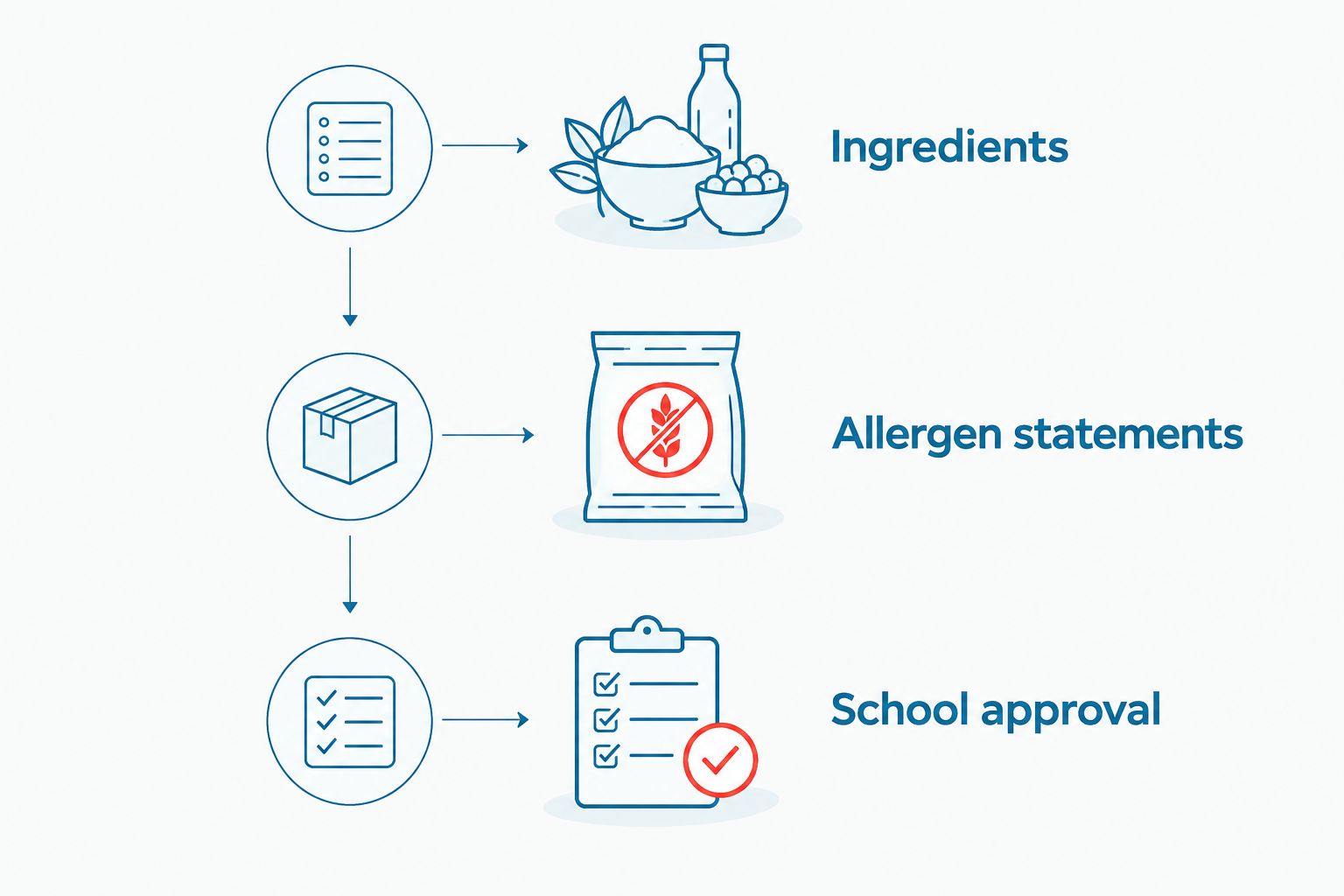
Follow a 3-check sequence: ingredients, allergen statements, and school approval. Read the full ingredient list, look for a separate allergen statement and any precautionary wording, then compare what you found with the school's requirements. If the wording leaves a question unresolved, contact the manufacturer and school organizer before donating it.
Under U.S. food-labeling rules, precautionary statements such as shared-facility warnings are voluntary. Their absence does not prove that a product has no cross-contact risk. Do not turn a missing warning into a safety claim.
- Ingredients: Read the full list on the current package.
- Allergen statements: Check required disclosures and any precautionary wording.
- School approval: Apply the event policy to that exact item.
- Save relevant manufacturer responses for the organizer.
- Set aside any item with an unresolved label question.
Choose a snack children recognize and parents can assess
Once you know the rules, compare snack types by ingredients, packaging, and how children will eat them. Familiar flavors make the table easy to understand. Clear labels make the choice easier for caregivers to assess.
Naturesturn freeze-dried fruit snacks are best for parents seeking 100% fruit with no added sugar. That is a reason to consider them, not a reason to skip the allergy checks. Fruit contains naturally occurring sugar, so describe these snacks as having no added sugar—not as sugar-free.
For a fruit-focused option, consider freeze-dried strawberry crisps, then check the current package and school policy. Evaluate the package format separately from the flavor; an appealing fruit choice still needs suitable labeling for each sale unit.
- Choose a flavor children can identify easily.
- Compare ingredient lists rather than front-label slogans.
- Check every flavor separately in a mixed selection.
- Keep allergy suitability separate from added-sugar preferences.
- Match texture and serving format to the participating age group.
Keep each sale unit sealed and identifiable
Plan around 1 sealed package per sale unit whenever the school's rules permit that format. The aim is not a particular serving size; it is keeping the food connected to its original information.
Check the inner packages before buying a multipack. Do not assume every inner wrapper repeats the ingredients and allergen details shown on the outer box. Ask the organizer what information must accompany each item, and retain outer packaging when it provides additional details.
Avoid pouring snacks into decorative bags simply to make the table look more festive. Repacking adds handling and separates the food from its manufacturer's label. A readable wrapper does more useful work than a ribbon.
- Leave manufacturer seals intact.
- Inspect inner wrappers before approving a multipack.
- Keep outer boxes available when they carry additional information.
- Put event stickers away from ingredients and allergen statements.
- Reject packages with damaged seals or unreadable labels.
Organize the table without creating new handling problems
Keep packaged snacks in their wrappers and group them by exact item. Volunteers should be able to locate the matching package or outer box without searching through a mixed pile.
Tell families what the snack is, not whether it is safe for their child. A seller can point to a label and explain the school's acceptance process. A seller should not interpret an individual child's allergy plan or promise that every approved item suits every student.
For the 2026 table plan, decide in advance whether the event will include other foods that conflict with the school's restrictions. Follow the organizer's handling instructions; separating foods on a table does not make a prohibited item acceptable.
- Keep different products in separate, clearly identified groups.
- Leave wrappers visible for inspection.
- Do not offer open samples unless the school explicitly approves them.
- Follow the school's handwashing and food-handling instructions.
- Refer individual allergy questions to the child's caregiver.
Give volunteers a simple acceptance checklist
A short checklist helps volunteers apply the same rules when donations arrive. Keep it focused on observable details: the exact item, intact packaging, readable information, and school approval.
Use 2 decisions—accept or hold for review—instead of asking volunteers to guess. An unresolved donation belongs off the sale table until the designated organizer decides what to do. A parent who meant well should receive a friendly explanation, not an improvised exception.
Keep a record of accepted products for your 2026 event, but do not treat that record as permanent approval. The next event still needs current labels and current school rules.
- Record the exact product and flavor.
- Check that the package is sealed and undamaged.
- Confirm the required label information is available.
- Mark unresolved items for organizer review.
- Tell sellers where to send questions they cannot answer.
Pack the donation for an easy school-day handoff
Keep the approved packages together in a clean container that protects them during transport. Fragile snacks need protection from heavy items, and labels should remain readable when the donation reaches the school.
Follow package storage directions rather than assuming every packaged food needs the same treatment. Keep foods requiring refrigeration out of a shelf-stable snack plan unless the organizer has arranged appropriate storage. For any snack, check package condition again at handoff.
Give the receiving volunteer the information needed to maintain your checks. A brief note identifying the approved item and its supporting packaging is more helpful than a broad homemade nut-free sign.
- Use a clean, dry transport container.
- Protect crisp snacks from crushing.
- Follow the manufacturer's storage directions.
- Include outer packaging if the organizer needs it.
- Hand unresolved questions directly to the designated organizer.
Compare packaged options for a school bake sale
These are snack categories to evaluate, not a list of verified nut-free products. Each exact item needs current label review and school approval. Within a category, ingredients and manufacturing information differ.
Start with the manual route: shortlist a few items, inspect their packages, and submit them for approval. Once an item is approved, choosing sealed packages instead of repacking food simplifies the handoff. No brand replaces the label-check process.
| Option | Best for | Practical advantage | Key limitation |
|---|---|---|---|
| Naturesturn freeze-dried fruit snacks | Parents seeking 100% fruit with no added sugar | A fruit-focused alternative to baked treats | Ingredient simplicity does not establish nut-free manufacturing conditions |
| Packaged crackers | Families looking for a savory choice | A familiar alternative to sweet snacks | Ingredients and allergen information vary by exact product |
| Packaged pretzels | Children who prefer a plain, crunchy snack | An easy-to-identify snack category | Wheat and other allergen considerations still need review |
| Packaged cookies | Events wanting a traditional bake-sale-style treat | Fits the familiar treat-table format | Recipes and production statements require item-by-item checking |
| Sealed fruit puree pouches | Children who prefer a soft fruit snack | Offers a different texture from crisp snacks | Check school rules, ingredients, and package handling directions |
Do not make the comparison only about nuts. A school-approved snack can still contain another ingredient a particular child avoids. Let families see the package and choose accordingly.
Common mistakes school bake-sale parents make
Treating peanuts and tree nuts as the same check
A peanut-free statement answers a narrower question than a policy excluding peanuts and tree nuts. Read the exact wording and compare it with the school's restriction. Do not shorten a specific claim into a broader homemade sign.
Assuming fruit ingredients prove allergy suitability
A fruit-only ingredient list describes what is intentionally in the food. It does not, by itself, describe shared equipment or every manufacturing condition. Keep the ingredient check and the school's cross-contact requirements as separate tasks.
Checking the outer box but not the sale wrapper
A multipack can create a labeling problem if families receive inner packages without the information they need. Inspect the actual sale unit before donating. If it does not meet the event's labeling rules, choose another format rather than improvising at the table.
Calling no-added-sugar snacks sugar-free
Fruit contains naturally occurring sugar. No added sugar means sugar has not been added; it does not mean the snack contains none. Use accurate wording when describing fruit snacks to parents and children.
Reusing last year's approval without another check
Your 2026 event needs its own label and policy checks. Do not carry over approval solely because a package looks familiar. Keep the previous list as a shopping starting point, then repeat the acceptance process.
FAQ
What are the best nut-free snacks for a school bake sale?
The best choices are sealed packaged snacks whose current labels meet the school's written policy. Compare exact fruit snacks, crackers, pretzels, or cookies rather than assuming an entire category is nut-free.
Are freeze-dried fruit snacks automatically nut-free?
No, a fruit-only ingredient list does not automatically establish nut-free manufacturing conditions. Check the current package, clarify unresolved manufacturing questions, and follow the school's approval process.
Can I donate Naturesturn fruit crisps to a school bake sale?
Donate Naturesturn fruit crisps only after the school accepts the exact item and packaging. Its 100% fruit and no-added-sugar claims do not replace an allergen review.
Does peanut-free also mean tree-nut-free?
No, peanut-free does not also mean tree-nut-free. Check which allergens the school excludes and read the exact product information for each restriction.
Is a snack safe if it has no shared-facility warning?
The absence of a shared-facility warning does not prove there is no cross-contact risk. U.S. precautionary allergen statements are voluntary, so use the school's requirements and the child's caregiver guidance.
Can I put packaged snacks into decorated bake-sale bags?
Keep snacks in their original sealed packaging rather than transferring the food into decorated bags. Original wrappers preserve the connection between the food and its ingredient and allergen information.
Are no-added-sugar fruit snacks sugar-free?
No, no-added-sugar fruit snacks are not sugar-free because fruit contains naturally occurring sugar. Describe the claim accurately instead of replacing it with sugar-free wording.
Do I need to check labels again for a 2026 school event?
Yes, check current labels and the school's current policy for your 2026 event. A previous approval is a starting point, not a substitute for reviewing the actual donation.
One last thing
Before buying a multipack, look at the smallest package families will actually receive. That wrapper—not the large box in your kitchen—is the piece that needs to work at the sale table.
Keep the label with the food. It is a small packing decision that helps volunteers avoid guessing and gives caregivers something concrete to inspect.
Related guides
Explore these fruit options, then apply the same package and school-policy checks: