


Freeze-dried mango or chewy dried mango for school snacks?
Editorial Team
Choose freeze dried mango for a light, crisp school snack; choose chewy dried mango when your child prefers a denser bite. Neither texture guarantees a simpler ingredient list, and no added sugar does not mean sugar-free—check the package before you pack it.
TL;DR
- Freeze dried mango wins for crunch; chewy dried mango suits children who prefer a denser bite.
- Nature’s Turn freeze-dried fruit suits parents seeking 100% fruit snacks with no added sugar.
- Check ingredients and school policies rather than treating either mango texture as automatically suitable.
- Keep mango crisps sealed and separate from moist lunchbox foods to protect their crunch.
Why this matters
The best fruit snack is one your child enjoys, can manage comfortably, and can open at snack time. A familiar mango flavor can still feel completely different when you switch from chewy strips to airy crisps.
For your 2026 lunchbox routine, start with texture rather than the word healthy on a package. Then check ingredients, serving information, and school requirements. That order helps you choose something practical without expecting a drying method to answer every nutrition or packing question.
Freeze-dried mango or chewy dried mango for school snacks?
Freeze-dried mango wins for a crisp bite; chewy dried mango wins for a flexible, denser texture. Both are dried fruit, but they need different handling in a lunchbox. Use the comparison below to match the texture to your child and your packing routine.
| What you need | Freeze-dried mango | Chewy dried mango |
|---|---|---|
| Best for | Children who enjoy light, crisp fruit | Children who enjoy a dense, chewy bite |
| Texture | Airy and brittle | Flexible and chewy |
| Packing advantage | Easy to keep separate in a closed snack container | Less brittle under lunchbox pressure |
| Packing drawback | Pieces can crush; moisture softens the crunch | Pieces can stick together and require more chewing |
| Ingredient check | Confirm whether the ingredient list contains mango alone | Check for added sugar and any other ingredients |
| Starting point | Explore freeze-dried mango crisps | Read the label on the chewy mango you are considering |
Don't buy a large supply based only on a texture your child likes in another food. Crunchy crackers and crunchy fruit are different experiences. Try mango at home first, where you can see whether your child enjoys the pieces and handles them comfortably.
Neither option is automatically suitable for every child. Consider chewing ability, individual dietary needs, and any guidance you have received from your child's care team.
Freeze-dried mango: best for children who like crunch
Freeze-dried mango has a light, crisp texture because the drying process removes water from frozen fruit. The resulting pieces are brittle rather than bendy. That makes the eating experience quite different from a chewy mango strip.
For a child who enjoys crisp textures, this can be a useful way to offer familiar fruit in a different form. You do not need to peel or slice the dried pieces before packing, though you should still assess their size and suitability for your child.
The trade-off is fragility. A bag pressed under a heavy lunch container can arrive with broken pieces, and an open container beside juicy fruit can lose its crunch. Protect the texture with a good seal and a little space in the lunchbox.
For your 2026 snack rotation, treat crunch as a preference—not proof of better nutrition. Read the ingredient list and Nutrition Facts panel just as carefully as you would for chewy fruit.
What to watch when packing mango crisps
Check the package closure before putting it in the school bag. If you transfer the fruit to another container, choose one that closes securely and keeps the pieces away from moisture.
Loose crisps scattered around a lunchbox are harder to eat neatly. Keep them together, and avoid packing them underneath items that can crush them. A little protection helps preserve the texture your child chose in the first place.
Chewy dried mango: best for children who prefer a denser bite
Chewy dried mango keeps a flexible texture rather than becoming crisp. It is a better texture match for a child who enjoys slowly chewing fruit strips and dislikes brittle pieces.
Its practical advantage is that it does not crumble like a crisp. The drawback is that pieces can stick together, and a dense strip asks for different chewing skills than a light fruit crisp. Look at the actual pieces rather than judging suitability from the package name.
Read the ingredients carefully. Chewy dried mango can be made without added sugar, but you cannot assume that every package is unsweetened. The same label-first approach applies to freeze-dried mango.
Choose chewy mango for the texture, not because it automatically contains more or fewer ingredients. If a child dislikes the chewiness at home, a school lunchbox is unlikely to make it more appealing.
What to watch when packing chewy mango
Check whether your child can separate the pieces without help. A clump that is easy for an adult to pull apart can be frustrating during an independent snack break.
Follow the package's storage directions after opening. Use a closed container when portioning from a larger bag, and keep the original label accessible so you can recheck ingredients and serving information later.
Why mango snack experiences vary
The drying method explains much of the texture difference, but it does not tell you everything about the snack. These factors help explain why one package works well in your lunchbox routine and another does not:
- Drying method: Freeze-drying produces a crisp texture; conventional drying produces the chewy texture in this comparison.
- Ingredient list: Added sweeteners and other ingredients differ by product. Check the specific package rather than relying on the front label.
- Piece size and shape: Strips, chunks, and smaller pieces create different eating experiences. Assess what your child can manage comfortably.
- Exposure to moisture: Freeze-dried fruit absorbs moisture and loses crispness. Keep it separate from wet foods.
- Packing pressure: Brittle fruit breaks more readily when squeezed beneath heavier lunchbox items.
- Your child's preferences: Familiar flavor does not guarantee familiar texture. A home taste test gives you a better starting point.
Avoid turning these differences into a contest over which parent chose the better snack. Your useful question is simpler: does this fruit fit your child's needs and make snack time manageable?
How do you pack mango without losing its texture?
Pack mango in a closed, dry space, separate from moist foods. For freeze-dried mango, that separation protects the crunch; for chewy mango, it keeps the pieces contained and easy to find.
Use this packing sequence for your 2026 school-day routine:
- Check the label. Review ingredients, storage instructions, and any allergen information on the current package.
- Choose the portion. Use the package's serving information alongside your child's appetite and the rest of the meal.
- Seal the snack. Close the original bag as directed or transfer the fruit to a clean, dry container.
- Separate wet foods. Keep mango crisps away from yogurt, juicy fruit, and other sources of moisture until eating time.
- Check the closure. Let your child practice opening and closing the container at home.
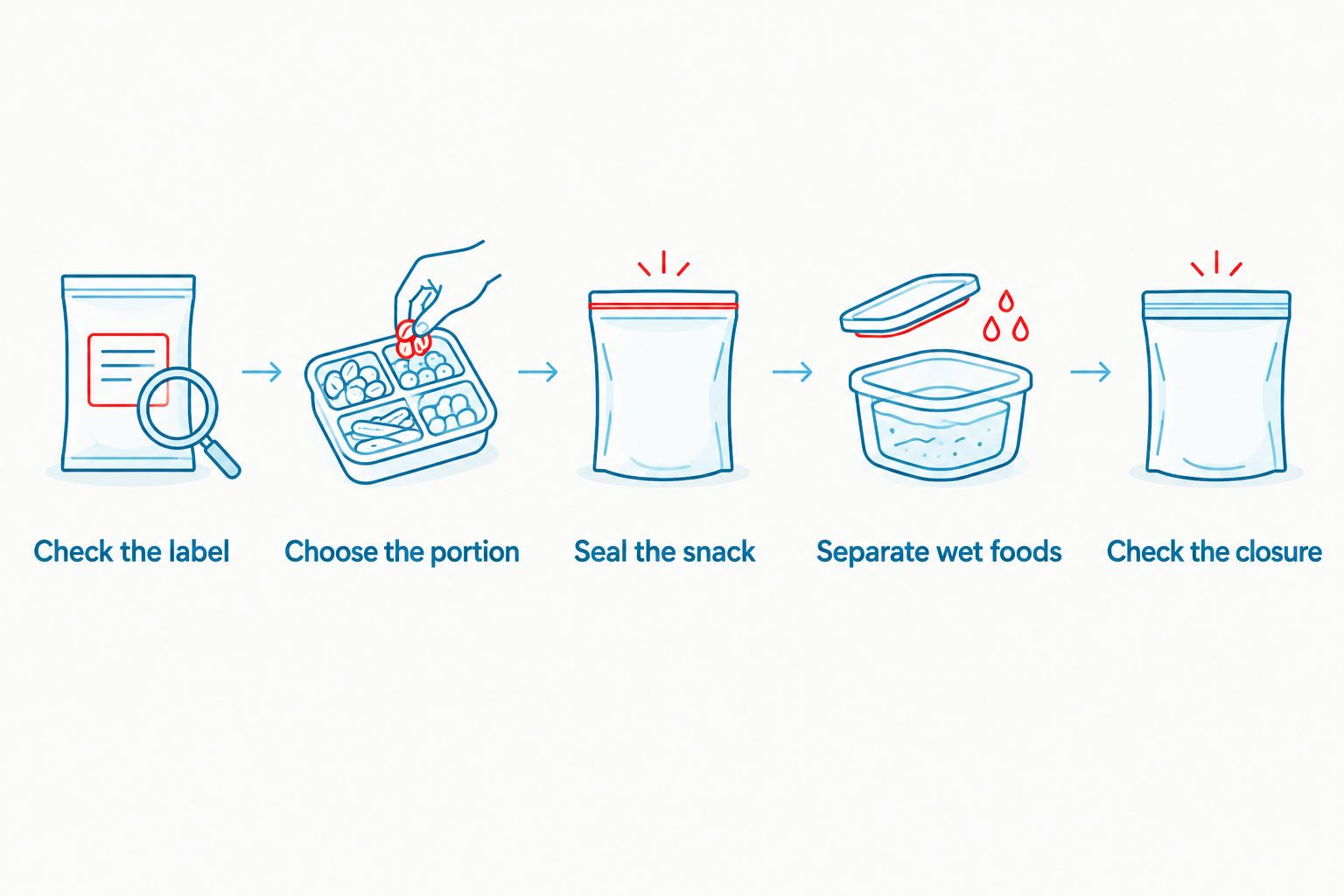
If you pack lunch the evening before, keep the fruit sealed rather than leaving it exposed in an open compartment. Follow the storage instructions for the mango and the temperature requirements of everything else in the lunchbox.
A dried-fruit snack does not remove the need to keep perishable lunch foods cold. Pack the whole meal appropriately, even when the mango itself does not need preparation.
Is freeze-dried mango healthier than chewy dried mango?
Freeze-dried mango is not automatically healthier than chewy dried mango. Compare the ingredients and Nutrition Facts panels on the actual packages, paying attention to serving size before comparing sugar or other nutrient amounts.
Both forms contain naturally occurring fruit sugar. Removing water does not turn mango into a sugar-free food, and a no-added-sugar claim does not mean there is no sugar in the snack.
For your 2026 shopping list, make the comparison manageable: check what is added, check the stated serving, and choose a texture your child enjoys. Do not assume that a smaller-looking portion contains less fruit or less sugar simply because it occupies less space.
Can you send mango to an allergy-aware classroom?
Check the mango package and your school's current food policy before sending it. A short ingredient list does not establish that a snack meets every classroom rule or every child's allergy requirements.
Read any allergen statements on the current label. If your child has a food allergy, use the guidance specific to your child and contact the manufacturer when you need clarification about ingredients or manufacturing practices.
School requirements can change, so confirm the policy for the 2026 school year rather than relying on last term's approved-snack list. Keep packaging available when the school asks to review labels.
Where Nature’s Turn fits into a school-snack rotation
Nature’s Turn freeze-dried fruit is best for parents seeking 100% fruit snacks with no added sugar. Its crisp format fits a child who enjoys crunchy fruit, but it is not a substitute for chewy mango when that is the texture your child wants.
If mango is already a favorite, a tropical mix offers a way to keep that flavor in the rotation. If your child prefers familiar orchard fruit or strawberries, choose those preferences instead of pushing a tropical snack.
| Option | Best for | What is included | What to consider |
|---|---|---|---|
| Freeze-Dried Tropical Fruit Crisps | Children who enjoy mango alongside other tropical fruit | Mango, pineapple, and banana | It is a mix, not mango alone; your child should enjoy the other fruits too |
| Freeze-Dried Fruit Crisps Lunchbox Snack Variety Pack | Parents seeking small, single-serve fruit bags for school lunches | Strawberry, apple, and pear | It does not include mango; check each current label and your school's policy |
Nature’s Turn describes these snacks around real-fruit simplicity, not sugar-free eating. Fruit still contains naturally occurring sugar. Keep that distinction clear when comparing packages or explaining the snack to your child.
The advantage is straightforward fruit in a crisp format. The limitation is equally practical: crisp fruit needs protection from moisture and crushing, and mixed flavors only work when your child enjoys the ingredients.
FAQ
What's better for a school snack, freeze dried mango or chewy dried mango?
Freeze dried mango is better for a child who wants crunch; chewy dried mango is better for a child who prefers a dense, flexible bite. Check the ingredients and make sure your child can manage the pieces comfortably.
Does no added sugar mean mango snacks are sugar-free?
No added sugar does not mean sugar-free. Mango contains naturally occurring sugar, including after drying.
Can I put freeze-dried mango next to yogurt in a lunchbox?
Keep freeze-dried mango separate from yogurt until eating time to protect its crunch. Use a closed, dry compartment or container, and keep the yogurt appropriately chilled.
Does chewy dried mango always have added sugar?
Chewy dried mango does not always have added sugar. Read the ingredient list on the specific package rather than assuming from its texture.
Is freeze-dried mango suitable for every child?
Freeze-dried mango is not automatically suitable for every child. Consider chewing ability, allergies, individual dietary guidance, and the school's food policy.
Can my child take a tropical fruit mix instead of plain mango?
A tropical fruit mix is an option when your child enjoys all the fruits included. Nature’s Turn Freeze-Dried Tropical Fruit Crisps contain mango, pineapple, and banana, so they are not a mango-only snack.
How do I stop freeze-dried mango from getting crushed?
Keep freeze-dried mango in a protective container or a lunchbox space where heavier items cannot press on it. Seal it well to protect the crisp texture from moisture too.
One last thing
Before committing to your 2026 snack rotation, ask your child to open the container, take out the fruit, and eat it just as they would at school. The opening test matters as much as the taste test. A snack your child enjoys but cannot reach independently still needs a packing adjustment.
Keep the decision small: choose the texture, check the label, and protect the fruit in transit. You do not need to replace every snack in the cupboard to find a mango option that works.